Google announced that Android has set a new internet speed record and surpassed iPhone. The claim is backed by two benchmarks — Speedometer 3.1 and LoadLine. It sounds impressive, but if you dig into the numbers, the real difference for users turns out to be more modest than the headline might suggest.
Google claims Android is now faster than iPhone. Image: macrumors.com
How They Determined Android Is Faster Than iPhone
Google stated that Android has set a new performance record in the mobile web, becoming the fastest mobile platform for internet browsing. The company cited two tests.
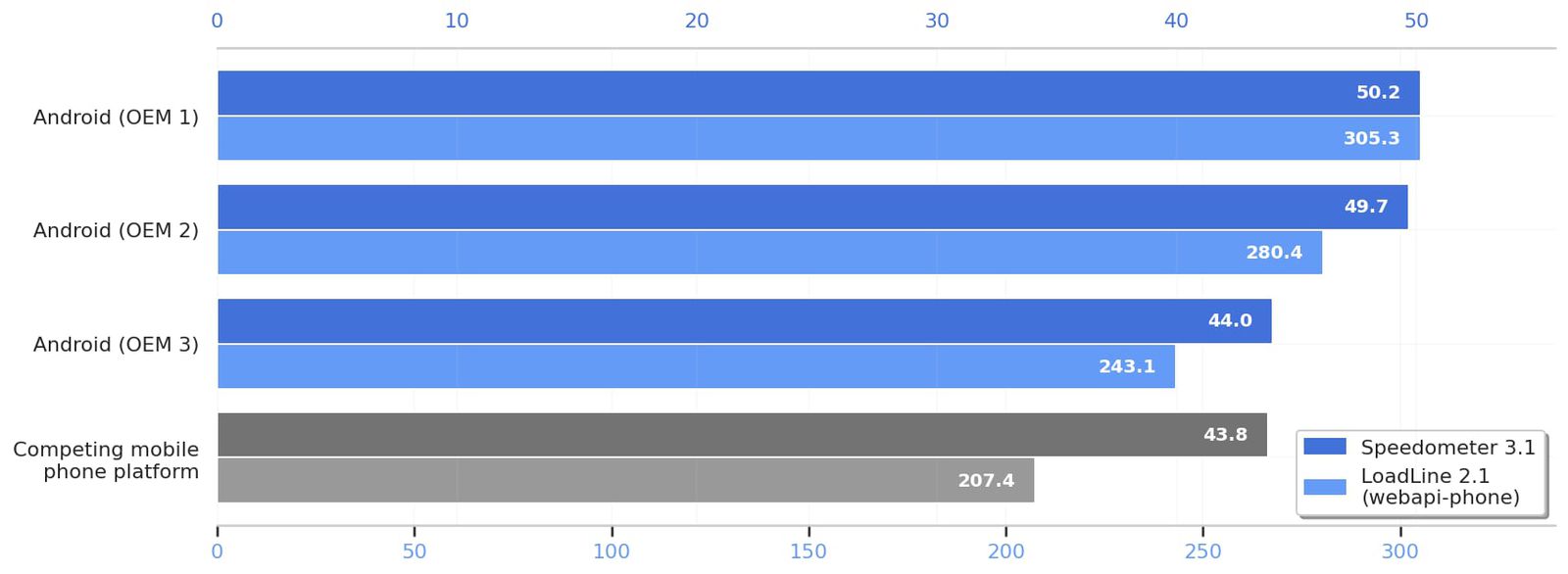
The first is Speedometer 3.1. This benchmark simulates real user actions in a browser and measures response latency — how quickly a page reacts to taps, scrolling, and typing. According to Google, a high Speedometer score means “a smoother, more responsive feel when interacting with a website.”
The second test is LoadLine. This is a new benchmark developed by the Chrome and Android teams that simulates the full web page loading cycle — from tapping a link to the moment the page fully appears on screen. Unlike traditional synthetic tests, LoadLine uses recorded versions of real websites — from online stores to search engines and news portals.
Naturally, Google’s tests favored smartphones running their OS. Did you expect anything else? Image: macrumors.com
In the charts published by Google, three unnamed Android devices scored higher in Speedometer 3.1 than an unnamed “competing mobile platform” — apparently iOS. In the LoadLine test, top Android smartphones showed results up to 47% higher than the competition.
How Much Faster Is Android Really Compared to iPhone in 2026
47% — a number that catches the eye. But context matters here. Some flagship Android smartphones improved their Speedometer and LoadLine results by 20–60% year over year compared to previous models. This is indeed significant progress in synthetic tests. However, Google itself acknowledges that for users, this translates to very different numbers.
In reality, we’re talking about a 4–6% improvement in page load times and a 6–9% improvement in the slowest interactions — those moments when a site “freezes” for a fraction of a second during a tap or scroll.
The gap between 47% in a benchmark and 4–6% in real life is a normal situation for any performance tests. A benchmark stresses the system with specific tasks and reveals the maximum gap. In a real-world scenario — when you open a news site or browse a store catalog — the difference is much more modest.
Why Chrome on Android Got Faster
Google reports that it worked jointly with processor and smartphone manufacturers, optimizing Chrome and the operating system’s kernel scheduler settings. The company attributes the record to “deep vertical integration of hardware, the Android operating system, and the Chrome engine.”
Essentially, this is the same approach Apple has been using for years: the tightest possible link between hardware and software. Google effectively acknowledges that raw processor power isn’t enough — what matters is how exactly the browser and the system use the device’s resources.
Safari remains a top browser. Image: macrumors.com
Google emphasizes that over 90% of Android apps use WebView (a built-in component for displaying web pages inside apps), so “the speed of the web determines the speed of your phone.” This is an important clarification: the optimization applies not only to the Chrome browser but also to all apps that display web content — from banking clients to marketplaces.
Why iPhone Still Holds Its Own Against Android in Internet Speed
There are several reasons to approach Google’s claims with healthy skepticism.
- The LoadLine test was created by Google itself. The benchmark was developed by the Chrome and Android teams — the very same people who optimized their platform for this test. It’s hard to call it independent.
- Device names were not disclosed. The tests were conducted on three unnamed Android flagships against an unnamed “competing mobile platform.” Which specific smartphones and which version of iOS were used remains unknown.
- The real difference is minimal. A 4–6% improvement in loading speed translates to fractions of a second on regular websites. Most users won’t notice the difference without a stopwatch.
- Browsers on iPhone run on the WebKit engine. Apple requires all browsers on iOS to use WebKit, so Chrome on iPhone is essentially Safari in a different wrapper. Comparing Chrome on Android with Safari on iPhone means comparing two different engines, not just two platforms.
iPhone or Android: Which Smartphone Is Better for Internet in 2026
This question comes up often, and the answer in 2026 is this: the difference in web browsing speed between a top Android smartphone and an iPhone is virtually unnoticeable in everyday use.
Google has done serious work on optimizing Chrome and Android. That’s a fact confirmed by benchmarks. But a few percentage points of improvement isn’t the kind of argument that should influence your platform choice. Website loading speed depends not only on the browser and processor but also on the quality of your internet connection, how well the website itself is optimized, and the amount of advertising on it.

In everyday scenarios, the speed difference between platforms is nearly unnoticeable
If you use an iPhone and are happy with the speed of Safari or Chrome — this Google announcement is no reason to worry, let alone switch platforms. If you’re on Android — updating your browser and system can indeed make web browsing slightly more responsive, especially on flagship devices. But “slightly more responsive” is an honest description of what we’re talking about: not a revolution, but an evolution by a few percentage points.