In 2026, English has stopped being just a line in your resume “for show.” It’s now a basic hygiene skill, the same as knowing how to use a smartphone or pivot tables in Excel. Globalization, remote work, and neural networks have erased borders, and employer requirements have become stricter.
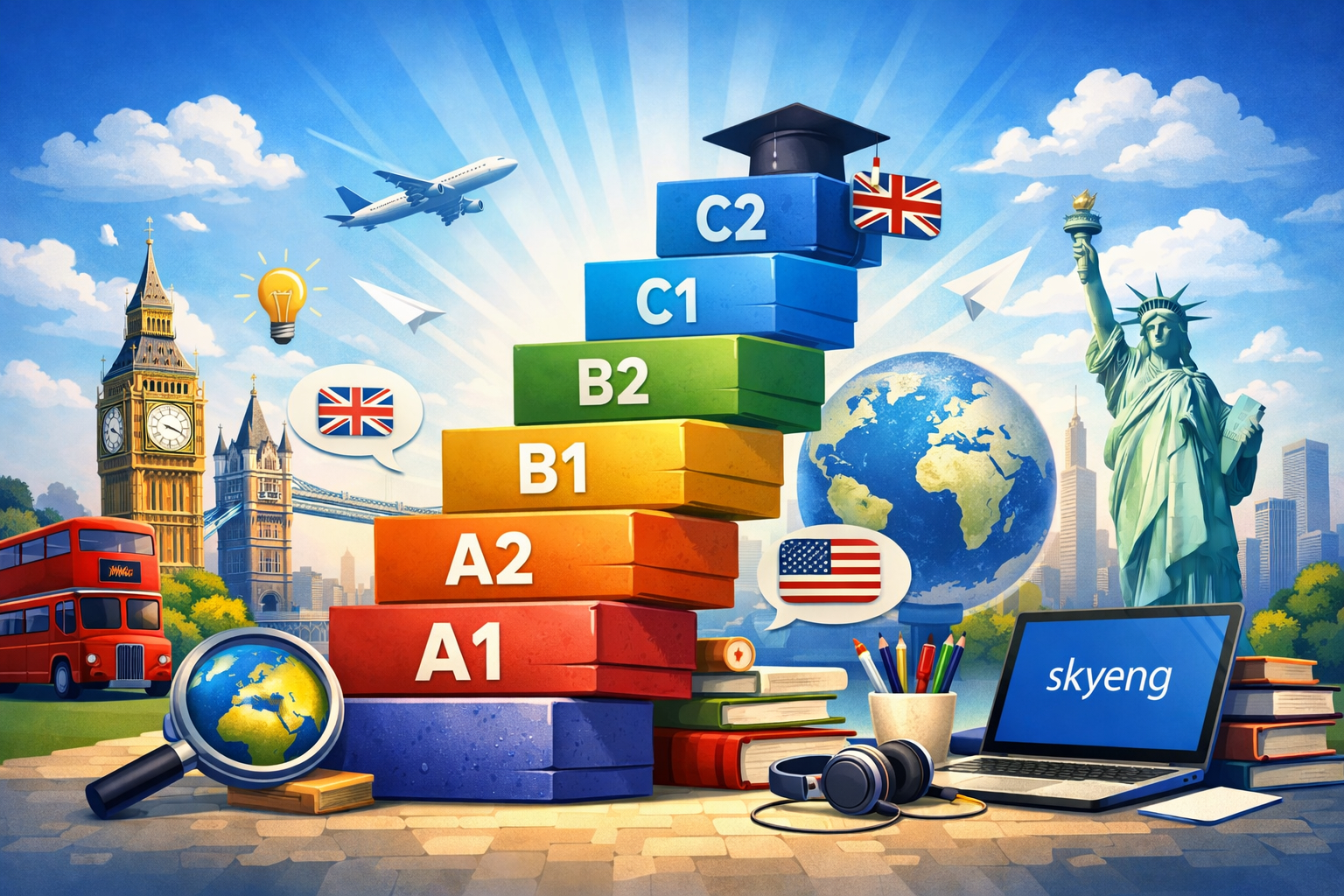
Do you understand the different levels of English?
Even with the emergence of powerful AI translators, the language barrier remains a problem. A neural network can translate a letter, but it won’t negotiate a raise for you or crack a joke during a coffee break. The CEFR system remains the only international standard that allows you to convert the abstract “I know the language with a dictionary” into an understandable metric. In this article, we’ll break down the technical side of the levels, look at real salary figures, and provide a step-by-step action plan.
What Are English Levels and the CEFR Scale (In Simple Terms)
CEFR (Common European Framework of Reference) is not just a boring chart from a textbook. It’s a universal coordinate system developed by the Council of Europe. It allows you to measure your skills regardless of where you studied — at a London school, with a tutor via video call, or on your own watching TV series.
The scale divides language proficiency into 6 levels (from A1 to C2). In 2026, these are the exact letters that HR directors, visa officers, and resume screening algorithms look at.
To make it easier, think of it as character evolution in a computer RPG game. You start with simple mechanics and gradually unlock new abilities:
- Level A1/A2: You’re a “Peasant.” You can buy bread, ask for directions, but a complex battle (negotiations) is beyond your abilities.
- Level B1/B2: You’re a “Knight.” You feel confident on a quest, can argue about tavern politics, and complete a quest without a dictionary.
- Level C1/C2: You’re a “Mage.” You possess secret knowledge (idioms, sarcasm), read ancient scrolls (Shakespeare, technical documentation), and sense nuances unavailable to mere mortals.
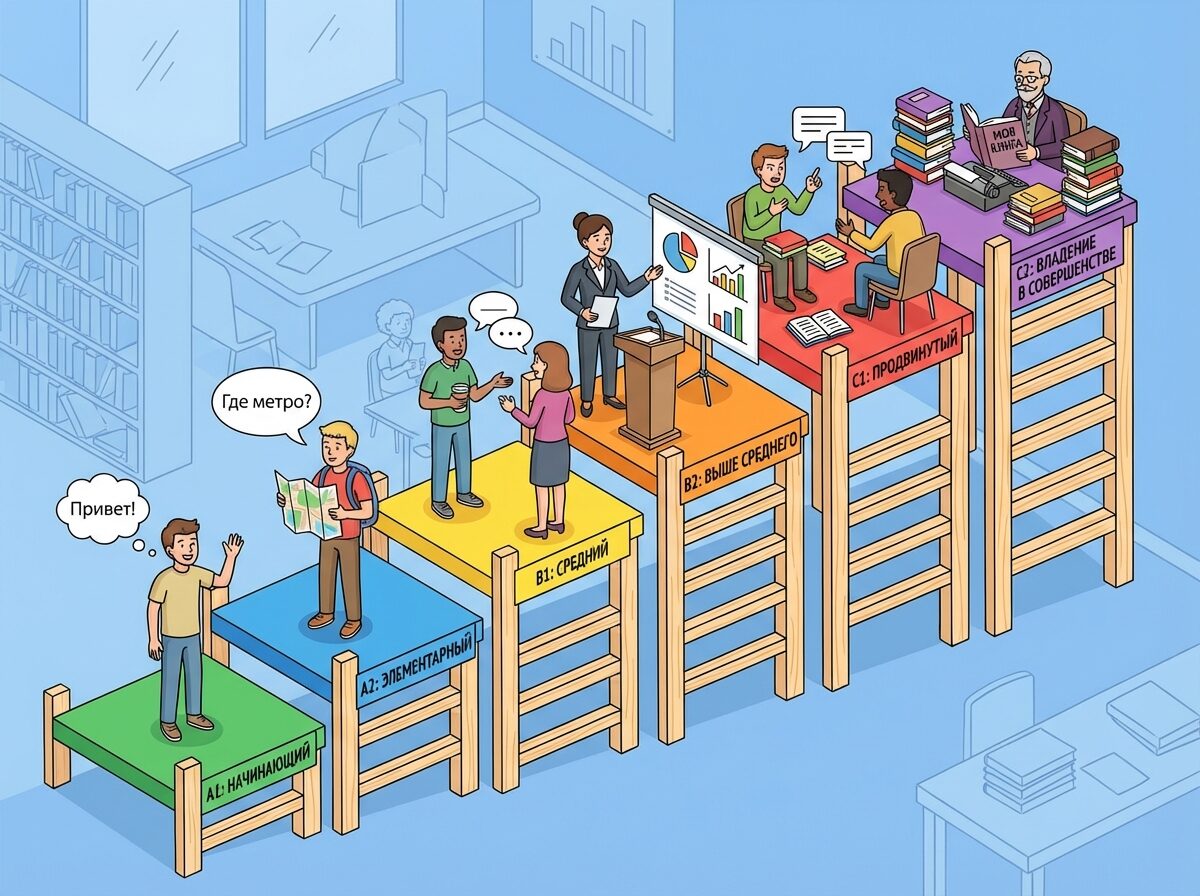
Levels are like steps with new knowledge
Summary Table of Levels: From Beginner to Proficiency
Below is the “dry” statistics. We specifically separated vocabulary into Active (what you use in speech) and Passive (what you understand in text). This is critically important: often we understand everything (Reading C1) but can’t say a word (Speaking A2).
| Level (code) | Role in the “game” | Vocabulary (units) | Key skill |
|---|---|---|---|
| A1 | Beginner | Active: 500–700 / Passive: up to 1,500 | Survival (basic needs) |
| A2 | Elementary | Active: 1,000–1,500 / Passive: up to 2,500 | Solving simple everyday tasks |
| B1 | Intermediate | Active: 2,000–3,000 / Passive: 3,000–4,000 | Independent communication |
| B2 | Upper-Intermediate | Active: 2,500–3,000 / Passive: 3,250–6,000 | Professional communication |
| C1 | Advanced | Active: 3,750–4,500 / Passive: 8,000–10,000 | Academic fluency |
| C2 | Proficiency | Active: 4,500–5,000 / Passive: 16,000+ | Educated native speaker level |
Detailed Breakdown: Self-Assessment Checklist
The CEFR classification groups skills into three leagues: A, B, and C. Let’s run a quick diagnostic. Honestly answer “Yes” or “No” to the items below.
Group A (Basic User) — Elementary Proficiency
Your status: Tourist.
This is the stage of “linguistic survival.” You won’t be able to discuss philosophy, but you won’t starve in a foreign country.
Checklist A1-A2 (You’re here if):
- I can order food at a café by pointing at the menu and naming dishes.
- I can explain to a doctor where it hurts (arm, leg, head) using simple phrases.
- I understand slow speech if the speaker pauses and helps with gestures.
- I can write a short message to a friend: “I’m here, waiting for you.”
But even this level gives you the exhilarating feeling of a first victory:

With this level, you can already comfortably buy coffee at a café
Group B (Independent User) — Independent Proficiency
Your status: Professional.
This group includes levels B1 (Intermediate) and B2 (Upper-Intermediate). This is where the magic of transitioning from studying to actual use happens.
Why is B2 the new norm?
In 2026, B2 has become the “entry ticket” to a normal life. Without it, it’s impossible to pass a job interview in IT, obtain a work visa (Blue Card), or watch Netflix without annoying subtitles. This is the point where you stop translating phrases in your head before saying them out loud.
Checklist B1-B2 (You’re here if):
- I can watch YouTube videos related to my profession and understand 80% of the content.
- I’m able to pass a job interview and talk about my experience, even with mistakes.
- I can write a work email to a colleague asking them to fix a bug or send a report.
- I can argue my point with a conversation partner, not just nod along.
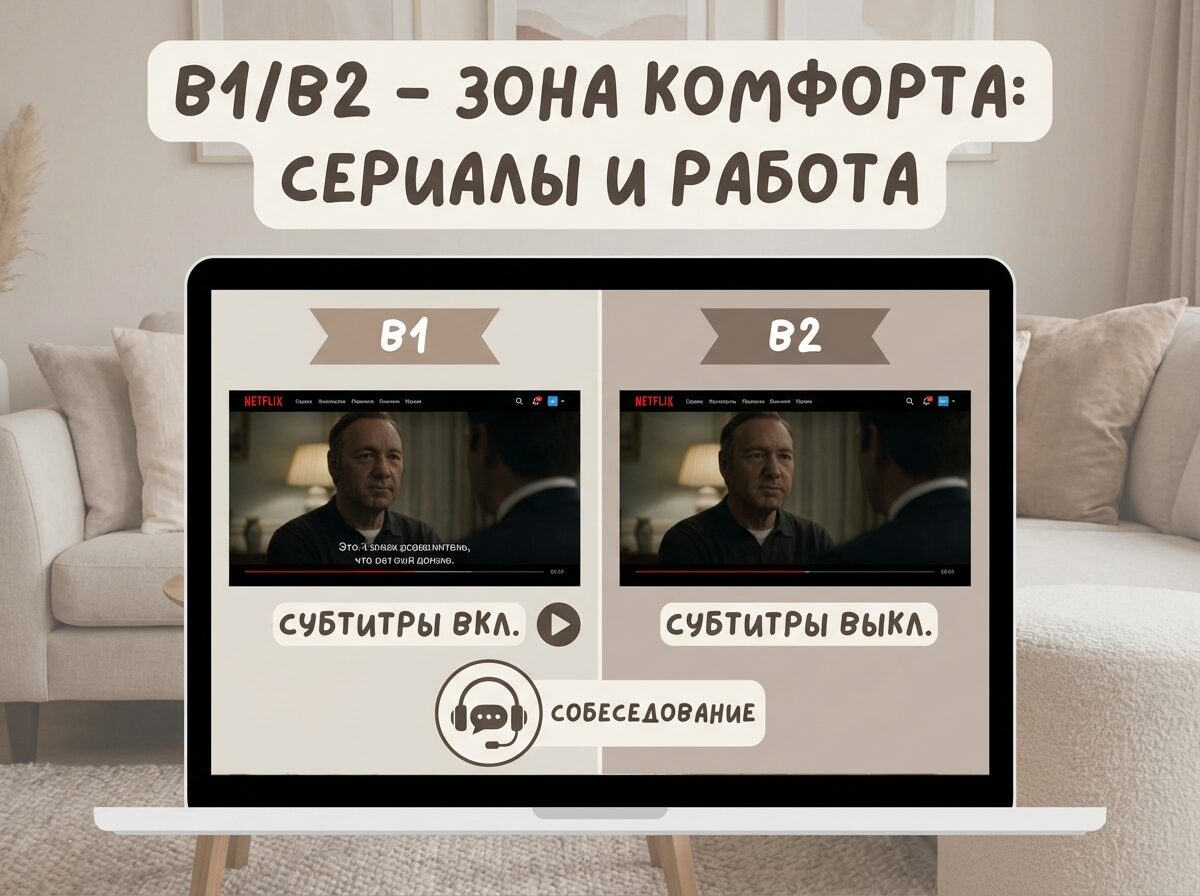
Watching TV shows without subtitles is a dream for many of us
Group C (Proficient User) — Fluent Proficiency
Your status: Expert / Mage.
Levels C1 (Advanced) and C2 (Proficiency) are the elite league. Few make it here, and it’s most often necessary for top management, academia, or teaching.
Checklist C1-C2 (You’re here if):
- I understand hidden meanings, irony, and sarcasm in native speakers’ speech.
- I can read technical contracts or scientific articles without a dictionary.
- I can speak at conferences and answer tricky questions from the audience.
- I can sense stylistic differences: when it’s appropriate to say “Hey dude” versus “Dear Sir.”
How to Determine Your English Level? (3 Methods)
You might think you know the language at a “solid B,” but the job market demands precision. How can you test yourself without illusions?
- Online Testing (Adaptive). The quickest way to get an approximate benchmark. Modern algorithms adapt to your answers: if you make a mistake, the next question is easier; if you answer correctly, it gets harder. This takes 15–20 minutes.
- The “Can-Do” Method (Self-Diagnosis). Use the checklists above. The main rule is to be honest with yourself. If you’re unsure whether you can perform that action — most likely, you can’t yet.
- Professional Audit. A trial lesson with a methodologist. This is the only way to see your “blind spots.” We often overestimate our speaking and underestimate our passive comprehension. An outside perspective puts everything in its place.
Comparing CEFR with IELTS, TOEFL, Cambridge, and Duolingo English Test
If you’re planning relocation or university admission, simply saying “I’m B2” isn’t enough. You’ll need certificates.
Important detail: Since January 2026, TOEFL iBT has switched to a new scoring scale (from 1 to 6), but many universities still require the old scores (Legacy). In the table, we provide both variants. We also added the Duolingo English Test (DET) — it has become mainstream due to its accessibility and speed of results.
| CEFR Level | IELTS | TOEFL iBT (New / Legacy) | Cambridge (FCE, CAE, CPE) | Duolingo English Test |
|---|---|---|---|---|
| B1 | 4.0–5.0 | New: 3.0–3.5 / Legacy: 42–71 | PET | 90–105 |
| B2 | 5.5–6.0 | New: 4.0–4.5 / Legacy: 72–94 | FCE | 110–125 |
| C1 | 6.5–7.5 | New: 5.0–5.5 / Legacy: 95–113 | CAE | 130–145 |
| C2 | 8.5–9.0 | New: 6.0 / Legacy: 114–120 | CPE | 150–160 |
How Much Is Your English Worth? The Impact of Level on Salary
Let’s talk about money. In the 2026 job market, English language skills have a direct monetization factor (Language Premium).
- IT and Big Tech: To work at companies like Google, Meta, or even for remote work on Upwork, B2 is the minimum entry threshold. Without it, you simply won’t be able to read the documentation.
- Relocation: Work visas in developed countries are rarely issued to specialists with a level below B2/C1.
- Salary: According to reports, specialists with a C1 level earn on average 18.8% more (US data) and up to 20% more globally [15] than their colleagues with an A2 level in the same position.
Specific figures by country (2026):
- USA: A developer with a C1 level earns an average of $115,000/year compared to $95,000/year at a B1 level.