The Duolingo app is one of the most popular language-learning platforms in the world. Millions of Russians use it to learn English, Spanish, French, and dozens of other languages in a gamified format. But on March 26, 2026, a Moscow court fined the company 2 million rubles for violating Russian personal data legislation. The precedent is alarming — LinkedIn was restricted following the same pattern, and the history of Telegram being blocked in Russia showed that even the most familiar services can be banned. Let’s break down what to expect next.
It seems the Duolingo block is just around the corner
What Is Duolingo
Duolingo is an American language-learning platform founded in 2011. Today it is one of the most downloaded educational apps in the world: according to the company itself, its audience exceeds 500 million users. The app is built on gamification: short lessons, a lives system, daily streaks, and competitions with other users. It’s precisely this approach that made Duolingo courses popular among those who previously couldn’t bring themselves to study languages from textbooks.
The Duolingo app offers more than 40 languages, including not only European ones but also Japanese, Chinese, Arabic, Hindi, and even Latin and Klingon. The basic version is free, while the paid Duolingo Plus subscription removes ads and adds extra features. Duolingo subscriptions in Russia are obtained through workarounds due to restrictions from Google.
Does Duolingo Work in Russia
At the time of writing, Duolingo in Russia officially works. The app is available on Google Play and the App Store, and lessons function normally. However, some users periodically report glitches: audio doesn’t load in lessons, and some audio-based tasks don’t work. Roskomnadzor officially denied involvement in these issues, explaining them as a side effect of blocking Amazon Web Services servers that Duolingo uses.
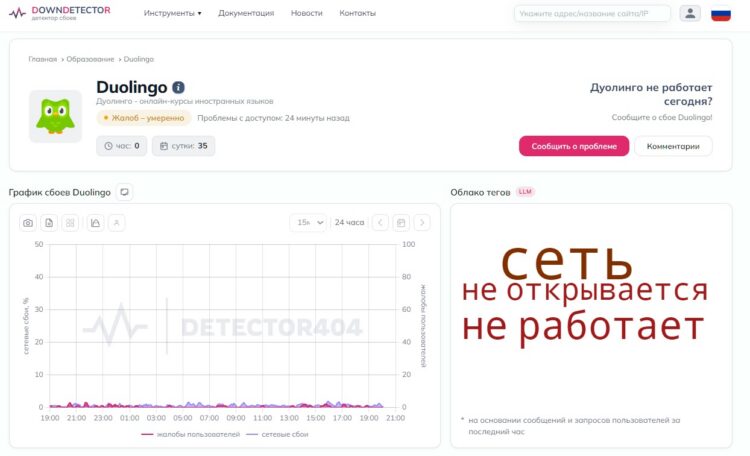
The service still works, but how long will it last? Source: detector404.ru
In reality, Duolingo doesn’t fully work for some Russian users already — not because of a direct block, but due to restrictions on CDN networks through which the service distributes audio content. There are no issues only when using a foreign IP.
Reasons for a Possible Duolingo Block
On March 26, 2026, a magistrate judge of Moscow’s Tagansky District fined Duolingo Inc. 2 million rubles under Part 8 of Article 13.11 of the Russian Code of Administrative Offenses. The stated violation was failure to ensure the recording, systematization, accumulation, and storage of Russian citizens’ personal data on Russian territory. In simpler terms, Roskomnadzor wants to block Duolingo for the same reason LinkedIn was once blocked: the company stores Russian users’ data on foreign servers and refuses to transfer it.
The playbook has already been tested. In 2016, LinkedIn received a similar order, refused to comply, and was blocked. Many other foreign services followed the same path. A 2-million-ruble fine for an American company with a multi-billion-dollar market capitalization is not a punishment but rather a signal. The next step in this logic is either compliance with the requirements or inclusion in the registry of blocked websites.

We’ve already said goodbye to LinkedIn
A Duolingo block will become real if the company ignores the court ruling and takes no steps toward data localization. So far, Duolingo Inc. has made no official statements on the matter. Meanwhile, American domain registrar eNom LLC received the same fine — indicating that Russian courts are systematically targeting foreign companies that don’t comply with data localization laws.
When Will Duolingo Be Blocked
There is no direct answer to this question: whether Duolingo will be blocked in Russia remains unknown for now. A fine alone does not mean an automatic block. Several months or even years may pass between the court decision and the service being added to Roskomnadzor’s registry — if the company begins negotiations or appeals the decision.
At the same time, history suggests that American companies rarely comply with Russian regulators’ data localization requirements — especially after 2022. Duolingo is being blocked in Russia only indirectly for now, through restrictions on related infrastructure. But if the company receives an order from Roskomnadzor and ignores it, a direct block could follow within weeks. As happened with Roblox: the service first started glitching, and then users faced a complete block. Stay tuned for updates — the situation is changing fast.
What to Do If Duolingo Gets Blocked
If Duolingo is banned in Russia, that doesn’t mean the end of language learning. There are plenty of alternatives, and some of them are on par with Duolingo in terms of functionality. Here’s what actually works:
- Lingualeo — a Russian service for learning English. It works through videos, texts, and gamified exercises. It stores data in Russia, so there won’t be any blocking issues;
- Puzzle English — another Russian project focused on English. It teaches through clips from TV series and movies;
- Memrise — a British service focused on memorizing words through flashcards and videos with native speakers. Supports more than 20 languages;
- Busuu — a platform with live feedback from native speakers. Suitable for those who want not only to learn words but also to practice speaking;
- Babbel — structured courses with an emphasis on grammar and conversational situations. Paid, but with a trial period.
If Duolingo’s languages were important to you specifically because of the gamified format and daily streaks, the closest experiences are Memrise and Lingualeo. If depth and structure matter, take a look at Babbel or Busuu. Russian services have a practical advantage in this case: they definitely won’t face the threat of being blocked due to data localization requirements.