To be honest, I’ve been using iPhones for a long time and have inevitably developed a “taste deformation.” That’s when you can’t appreciate any smartphones other than Apple ones: something’s off here, something’s weird there. But I started my journey with Android in hand — and it seems I have every chance of making friends with it again. At least, that’s what I thought when I first started testing the POCO X8 Pro. But what did I conclude after finishing this review? Read on and you’ll find out.
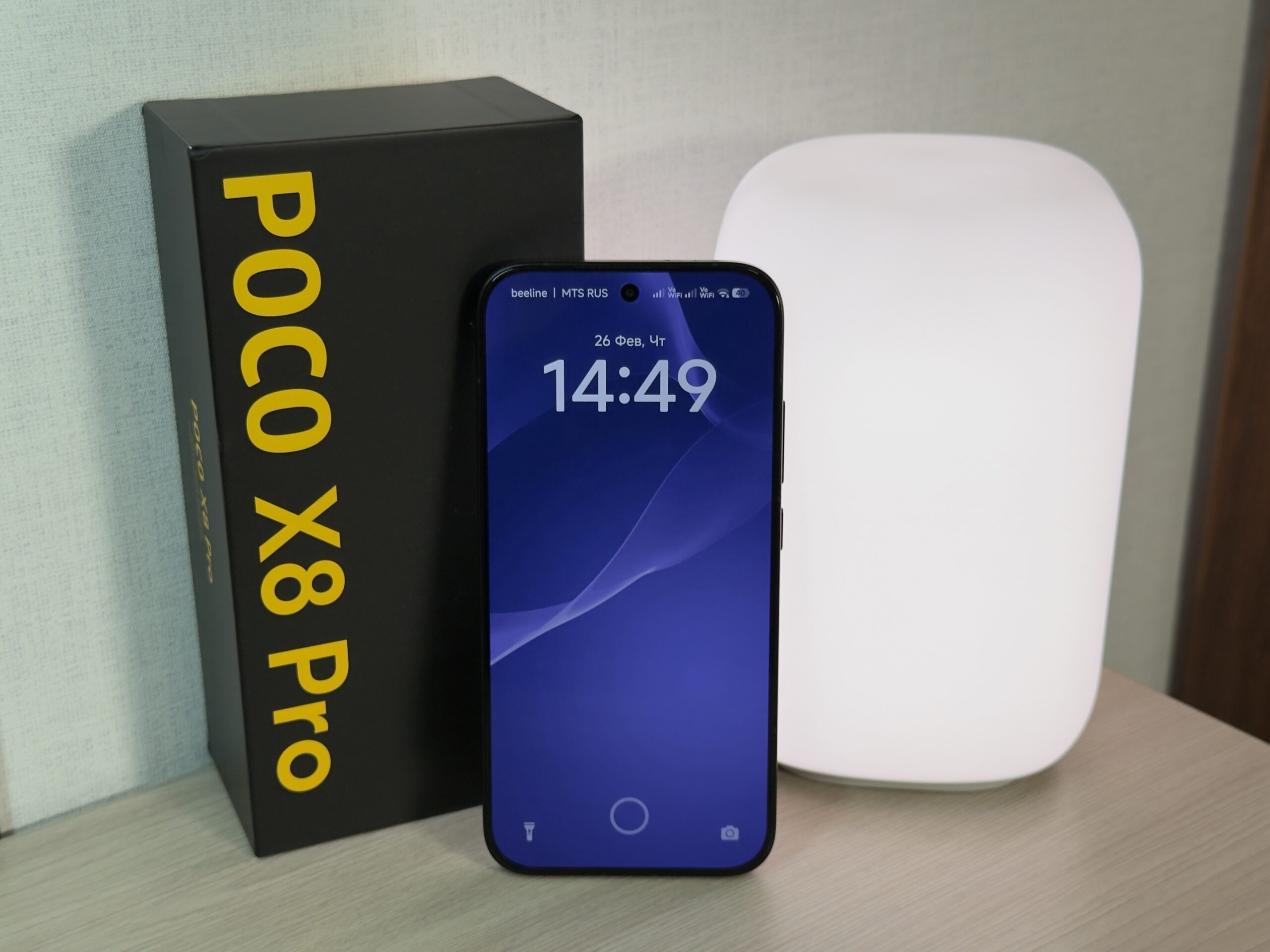
The new device is already here — it’s the POCO X8 Pro
So, I unboxed the POCO X8 Pro saying “wow, what a cool thing” and throughout my time using it, I encountered more “wows” and “whoas.” And these are the words of someone who uses flagship iPhones and MacBooks. So what exactly impressed me so much about this smartphone?
POCO Smartphone Package Contents
What I love about Android-based devices is the packaging. No EU laws apply here, so in the box you get not only a smartphone but everything you need to use it. And sometimes even more. Today’s review features just such a device: its package contents are a bit more generous than most other phones.
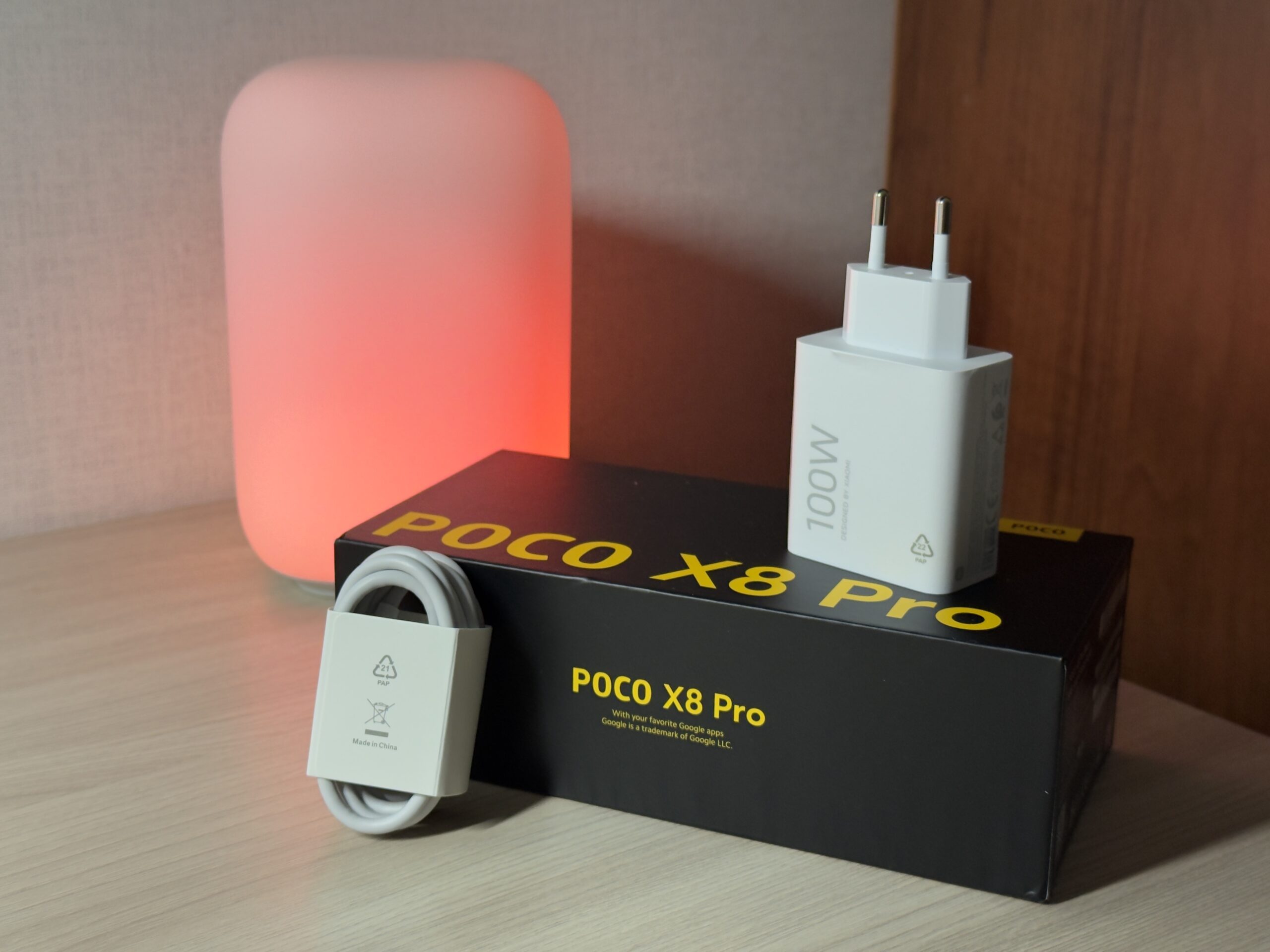
A charger included with the phone — a rarity these days
Specifically, in the box you’ll find:
- smartphone
- 100W charger
- thick USB-C cable
- branded case
- screen protector film
- booklets
I’m aware of the memes about how an Android owner gets not just a device with a charger, but also a film, a case, a beach vacation, and a country house thrown in — that’s how generous the manufacturers are. But jokes aside, buying an expensive phone for 100 thousand rubles (hello, Apple) and then having to buy a charger separately (hello to you too, Samsung) — that’s a strange approach. Here, the phone is three times cheaper, but everything’s included, and without any catches: the POCO X8 Pro supports very fast charging, so the included brick is a full 100W, not some measly 20W unit just “for show.” And a thick cable to go with it.
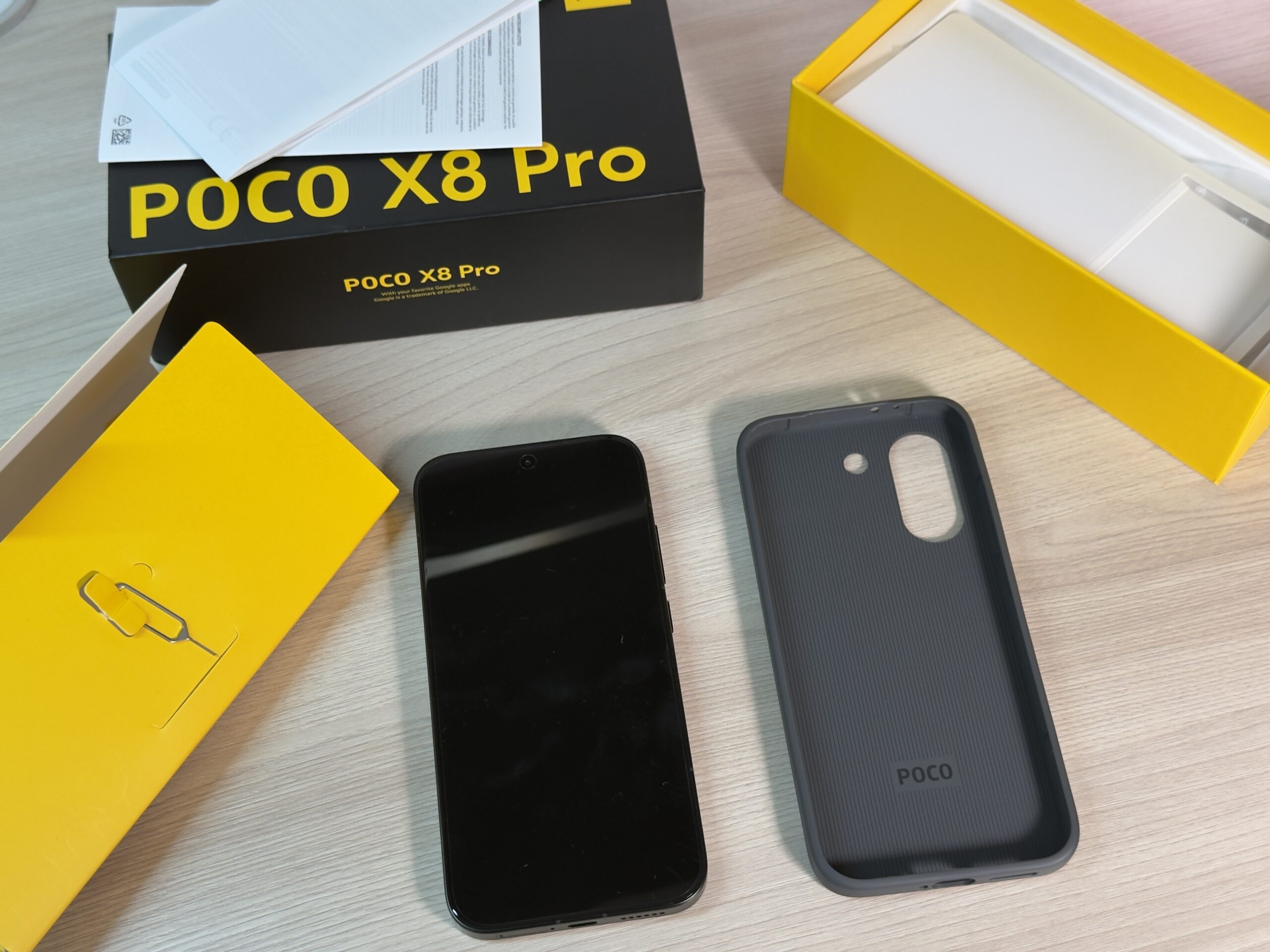
Just like the good old days
The case is simple: silicone, opaque. Sure, it’s no Pitaka, but you don’t need to buy one — it’s already included. And that’s great because the phone is still new, and accessories for it don’t appear in stores right away. For those worried about scratches on the frame and camera island — it’s just right. And the screen comes with a factory-applied protector film, so you can safely wait until tempered glass options hit the market.
The SIM Tray Surprised Me
This is actually a funny thing. I’m a diehard Apple user, but I was setting up this phone with some kind of childlike excitement. Imagine: I was thrilled by the SIM tray. Is that even normal? Here’s the thing.
With iPhones it’s like — insert the SIM and that’s it. Want a second one? Set up eSIM. But with the POCO X8 Pro, I open the tray and expect (from old memories of Android 7 era smartphones) to see a long sled for two SIM cards, plus a microSD slot. But what do I actually see? I poke the hole with a pin — and a tiny tray for one nano SIM card falls into my hands. Where’s the second one? They promised!
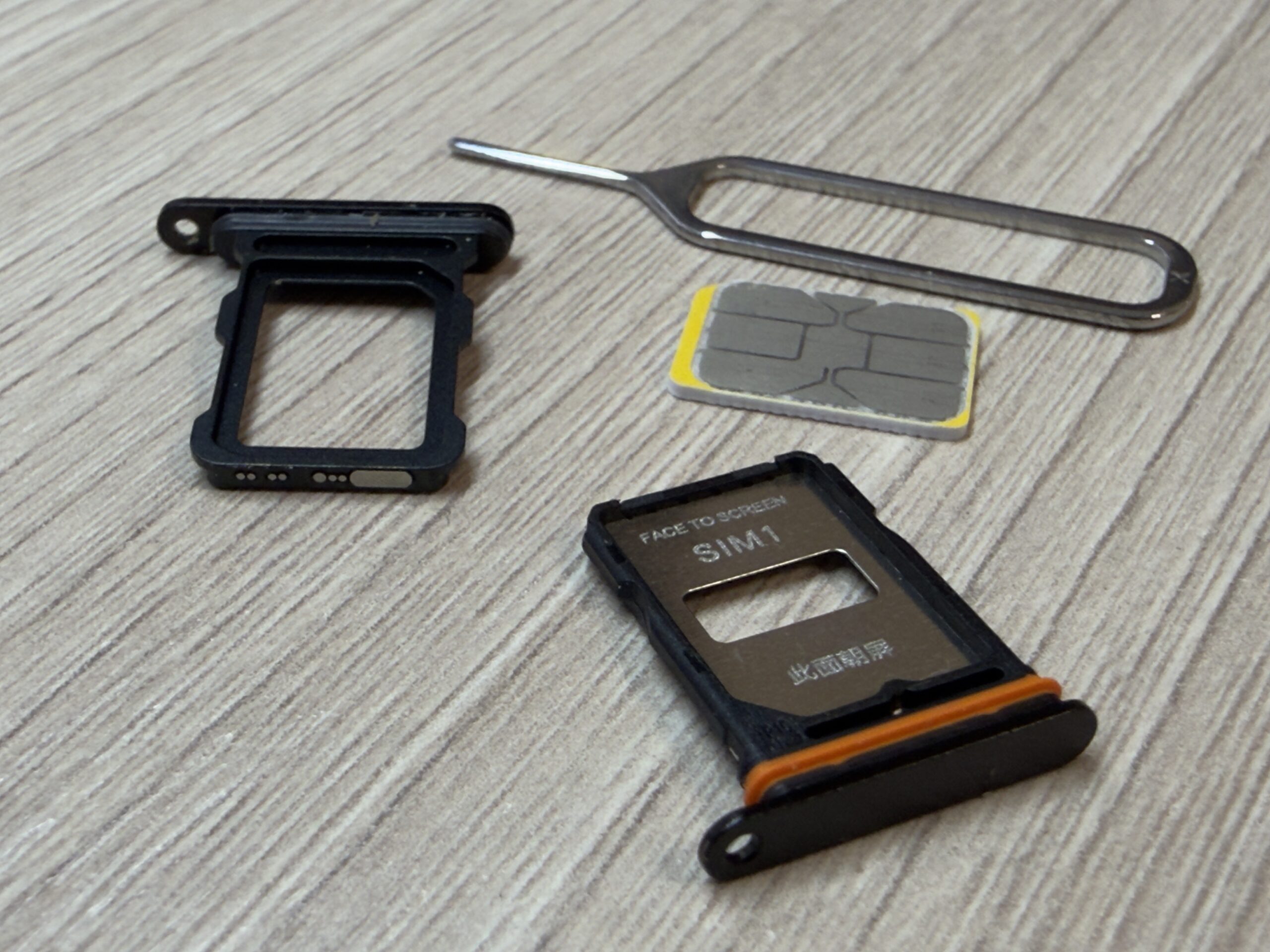
Left and further away — from the iPhone, right and closer — from the POCO
After a couple of seconds of twisting and turning this little piece in my hands, I discovered — it’s on the other side. Now that’s clever, I must say, my respects. They didn’t forget to label where SIM1 and SIM2 go, and there’s even an indicator showing which way to correctly insert the tray.
So yes, a lot of text for just one tray, but this micro-detail seemed important to me. At least because I genuinely felt the attention to detail — and this is in a smartphone positioned as an affordable sub-flagship. Also, the tray has SIM retention, so during installation, the card doesn’t fly out or go in crooked. iPhones don’t have this feature: there, to install the SIM, you need to position the tray with the SIM facing up so it doesn’t fall out. Anyway, that’s already the second “wow” today. Let’s move on.
How the POCO X8 Pro Design Has Changed
I open the box, take out the smartphone — at that moment my wife walks into the room asking: “Oh, is that an iPhone?” In short, at first glance this POCO X8 Pro really does look very similar to the iPhone 16 Pro, especially if both are in black. Probably upon detailed examination and study, the difference in materials would be noticeable, but the POCO has a metal frame with a pleasant texture.
Objectively, the back panel looks more interesting than the previous model
I can’t say the phone really stands out with a unique design, but if we talk about it in the context of previous and even older generations of the same POCO X series, then progress is noticeable. For example, the phone’s corners have become more rounded, which already gives it a fresh and even premium feel. The same effect comes from the new back panel, which is now entirely matte rather than split into two parts.
It looks nice
Separately, I want to highlight the thin display bezels: they’re exactly the same thickness as on the iPhone 16 Pro. And the latter, by the way, was presented with a specific emphasis on this feature. I think that’s already the third “wow.”
The bezels impressed me — the front panel looks fresh and tech-forward
And one more pleasant upgrade: the POCO X8 Pro now uses an advanced OLED panel with flexible cable routing. What does that mean? It means there’s no longer a so-called “chin” at the bottom of the screen, and the display has bezels of equal thickness all around. Previously, only expensive flagships had this — and it looks great. Especially if you enable gesture navigation and get rid of the classic Android navigation buttons.
Like twins, just with an age difference
And at the last moment, I discovered a fun thing — it turns out the smartphone supports light effects. While iPhones can flash their flashlight in sync with notifications and calls, here there’s a dedicated backlight for this. It’s LED-based, multicolored, and with adjustable brightness.
These circles smoothly shimmer during a call and flash with notifications
You can choose from eight shades total, and the color for incoming calls and notifications is set individually. Convenient, overall.
POCO X8 Pro Specifications
The junior sub-flagship (that’s right, because the senior one is the POCO F8 Pro, which we’ve already shown you) turned out interesting on the outside, but what’s inside? There’s a pretty solid setup here.
| Model | POCO X8 Pro |
| Screen | OLED, 6.59″ |
| Resolution | 2756 × 1268 (1.5K) |
| Refresh rate | 120 Hz |
| Peak brightness | up to 3500 nits |
| Processor | MediaTek Dimensity 8500 Ultra |
| RAM | 8/12 GB LPDDR5X |
| Storage | UFS 4.1 |
| Battery | 6500 mAh |
| Charging | 100W (wired) |
| Reverse charging | 27W (wired) |
| Main camera | 50 MP, OIS |
| Ultra-wide | 8 MP |
| Front camera | 20 MP |
At the heart of the new device is the MediaTek Dimensity 8500 Ultra chipset. It’s a powerful octa-core processor with graphics on par with expensive devices — for example, it supports ray tracing in games. There’s also 12 GB of RAM here, though the base version only has 8 GB. But even that’s a decent figure, considering both variants come with fast LPDDR5X memory. Internal storage starts at 256 GB in the base model, and 512 GB in the slightly pricier version. Basically, there’s plenty of storage room to work with.
The microphone is next to the tray, and the dots are the speaker
The only thing that slightly dampens the impression is USB-C version 2.0. It’s a convenient modern port with fast charging support, but with limited data transfer speeds. However, if you’re not transferring movies weighing several dozen gigabytes over cable, this shouldn’t worry you at all.
Comparing POCO X8 Pro Performance
A fair question from a future POCO X8 Pro owner — what can this smartphone actually handle? Photoshop, games, neural networks, or maybe its own shell barely runs? Traditionally, benchmarks answer this question. I always trust two: Geekbench and AnTuTu. Yes, they show arbitrary units, and that’s exactly what you need to compare your device with others.
In the Geekbench 6 test, the Dimensity 8500 Ultra scored 1700 points in single-core mode and just over 6600 points in multi-core. If we trust similar tests, the Galaxy S24 Ultra based on Snapdragon 8 Gen 3 produces the same multi-core figures. And in single-core performance, our hero is somewhere around Snapdragon 8 Gen 2 level. I think that’s impressive.
Pretty good numbers for a junior sub-flagship
Now AnTuTu. I ran the test, watched the pretty pictures and ray-traced graphics, and was amazed at how much everything has changed since my HTC Desire S, Google Nexus 5, and Samsung Galaxy S7 days. After the test, the benchmark returned 2,075,119 points. In a vacuum, this number doesn’t mean much to me, so I turned to test results from other devices. With similar scores we have:
- POCO F7 Pro (12 GB) — 2,193,049 points
- HONOR 400 Pro (12 GB) — 2,188,967 points
- iQOO Z10 Turbo (12 GB) — 2,027,257 points
- Samsung Galaxy S265 FE (8 GB) — 2,011,033 points
Overall, there’s not much more to comment on, except that one could assume the version with 12 GB of RAM would score a bit higher in this test and might possibly overtake last year’s POCO F7 Pro.