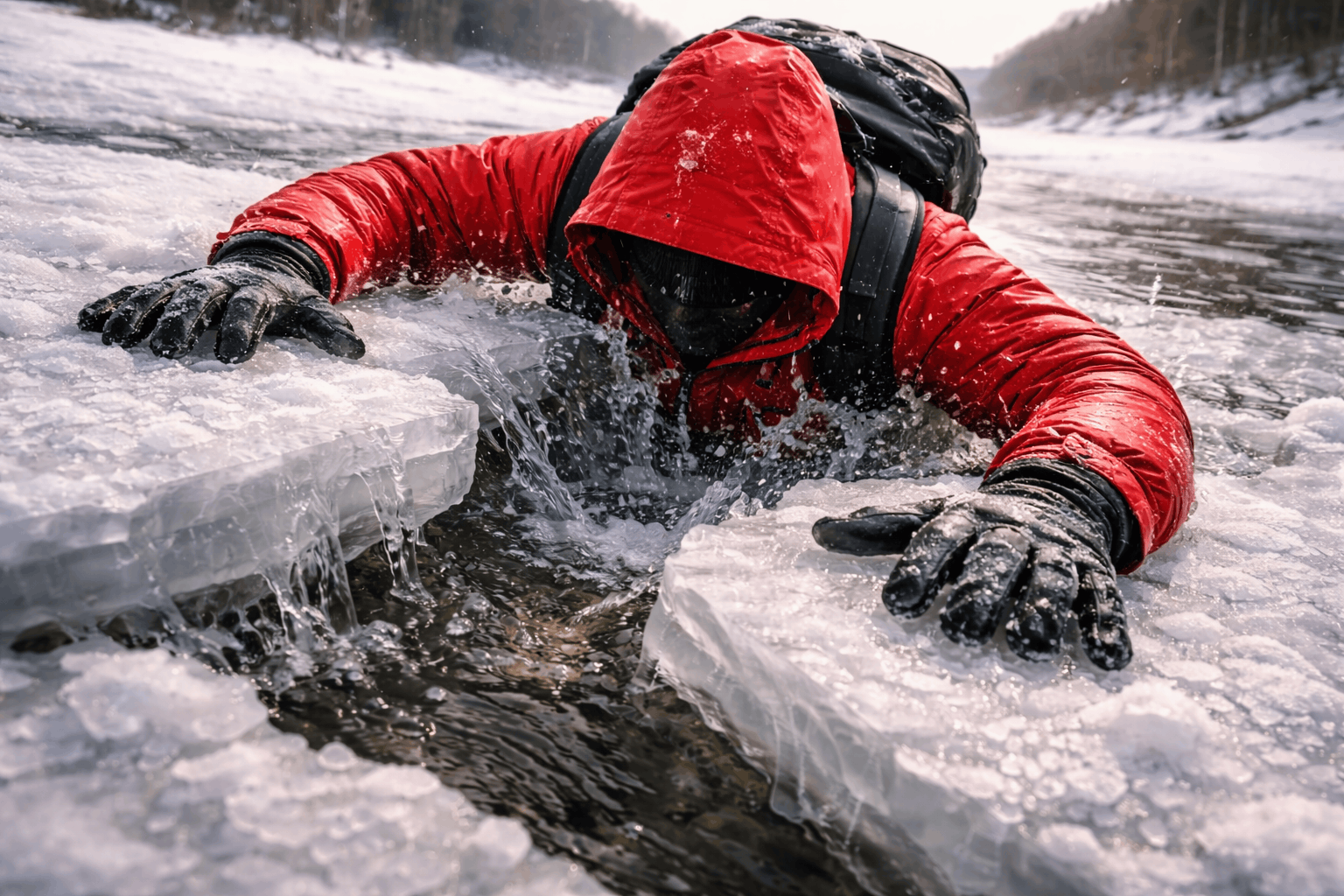
Dangerous ice! It is precisely at the end of winter that people fall through it most often.
In January, ice seems reliable. The frost holds, the surface is dense, fishermen calmly walk out to the middle of the river. But it is precisely in February that the statistics of falling through ice begin to rise. And it’s not about bad luck — it’s about physics. Ice at the end of winter changes its structure — on the outside it may look solid, while on the inside it is already loose and weakened.
Why River Ice Loses Strength in February and Where It Is Thinnest and Most Dangerous
The main reason is temperature fluctuations. During the day, the sun is already noticeably more active, while at night it still freezes. Water under the ice begins to move slowly, especially in rivers with currents.
As a result, spring porous (rotten) ice or so-called needle ice forms: crystals elongate and lose cohesion with each other.
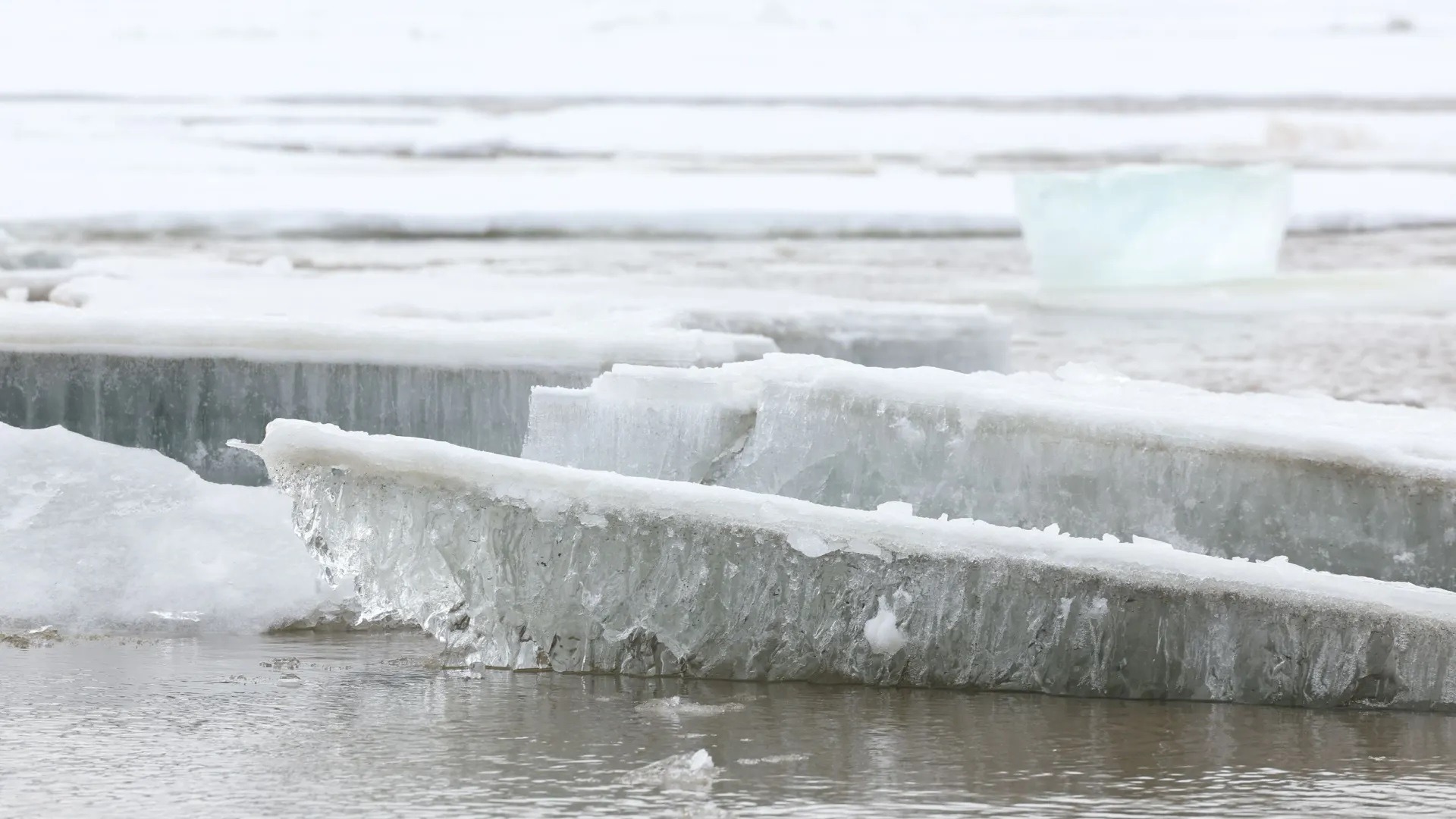
At the end of winter, when the sun intensifies and the thaw cycle begins, the ice structure changes and the risk of falling through grows rapidly. Image source: sever-press.ru
On the outside, the surface remains white and hard. But the load-bearing capacity drops. The thickness may remain the same, but the strength can be tens of percent lower. Especially dangerous are:
- areas with fast currents;
- places where streams and wastewater flow in;
- zones near bridges and supports;
- spots with dark patches and puddles on the surface.
It’s important to understand: snow on ice acts like a blanket. It retains heat, accelerating melting from below.
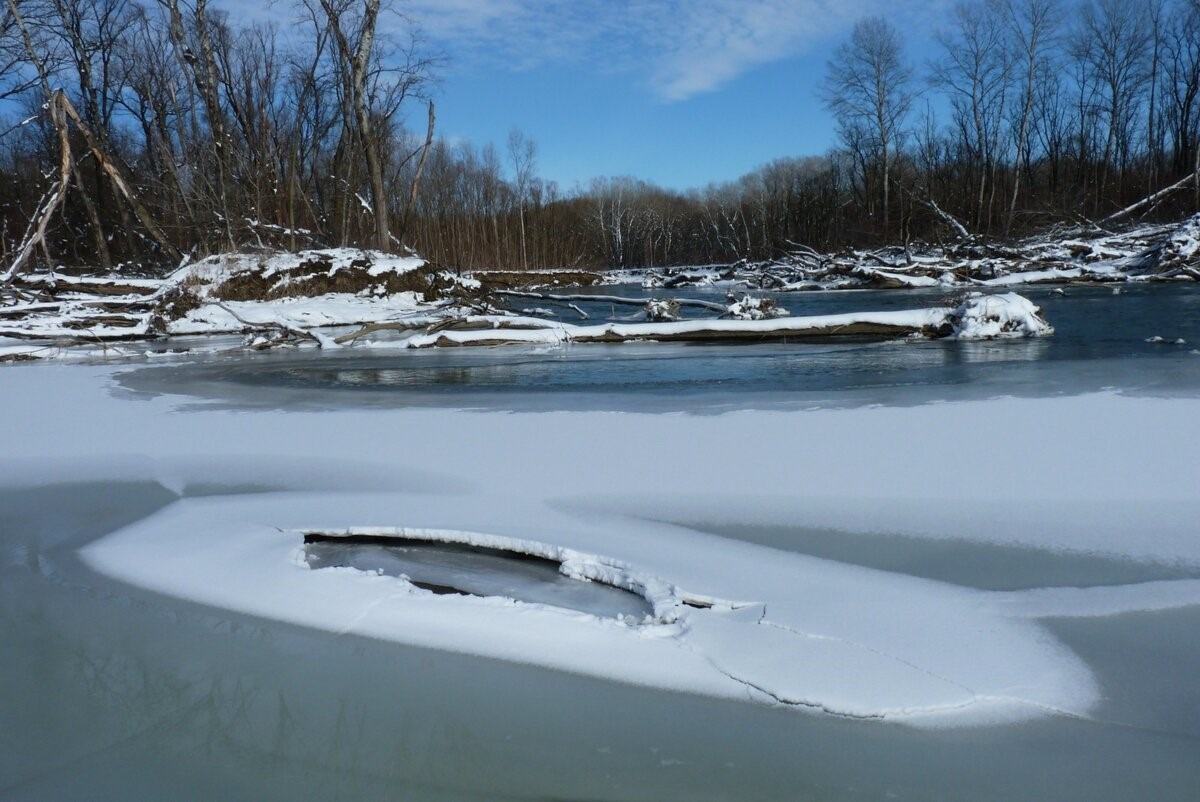
River ice is more dangerous than lake ice due to currents and localized “thin spots,” and snow indeed acts as insulation both at the beginning and end of winter. Image source: dzen.ru
Signs of Dangerous Ice: How to Tell That Going on the Ice Is Unsafe
How can you tell that the ice is already dangerous? There are several warning signs:
- cracking underfoot without visible cracks;
- a wet surface at below-zero temperatures;
- a matte, porous color of the ice;
- water appearing on the surface after stepping.
A thickness of 7–10 cm of high-quality new transparent ice is considered safe for a single pedestrian — and this does not apply to rivers with currents. For a group — 12 cm or more.
But in February, relying on ice thickness alone is no longer enough, because the ice is not new and its structure is no longer the same.
The main rule for the end of winter — don’t trust the appearance of ice. If there is any doubt, go around the area. A river in February is more treacherous than in January, even if it looks just as frozen.