Claude AI from Anthropic is one of the main competitors to ChatGPT and Gemini in 2025–2026. Former OpenAI employees created a neural network that outperforms competitors in working with code, long documents, and complex reasoning. In this article, we break down what Claude can do, how it differs from ChatGPT and Gemini, how to register from Russia, and whether it’s worth paying for a subscription.
Arguably one of the best neural networks today
What Is Claude AI and Who Created It
Claude is a family of large language models developed by Anthropic. The company was founded in 2021 by Dario and Daniela Amodei — brother and sister who previously worked at OpenAI. Dario held the position of Vice President of Research, and Daniela was responsible for safety policy.
Claude was created by former OpenAI employees who participated in building ChatGPT
The reason for leaving OpenAI was disagreements about the approach to AI safety and the partnership with Microsoft. The Amodeis believed that OpenAI was commercializing too quickly and not paying enough attention to risks. Anthropic was conceived as a company that would build powerful AI models but with an emphasis on safety and transparency.
Anthropic’s key principle is the so-called “Constitutional AI.” The idea is that the model is trained to follow a set of rules (a constitution) that define its behavior: be honest, avoid harm, acknowledge mistakes. In practice, this means Claude “hallucinates” (invents facts) less frequently and handles ethically complex queries better.
Claude Opus, Sonnet, and Haiku Models: Differences and Capabilities
Anthropic offers three model lineups, each designed for different tasks. But be prepared that getting access to Claude from Russia will require some extra effort:
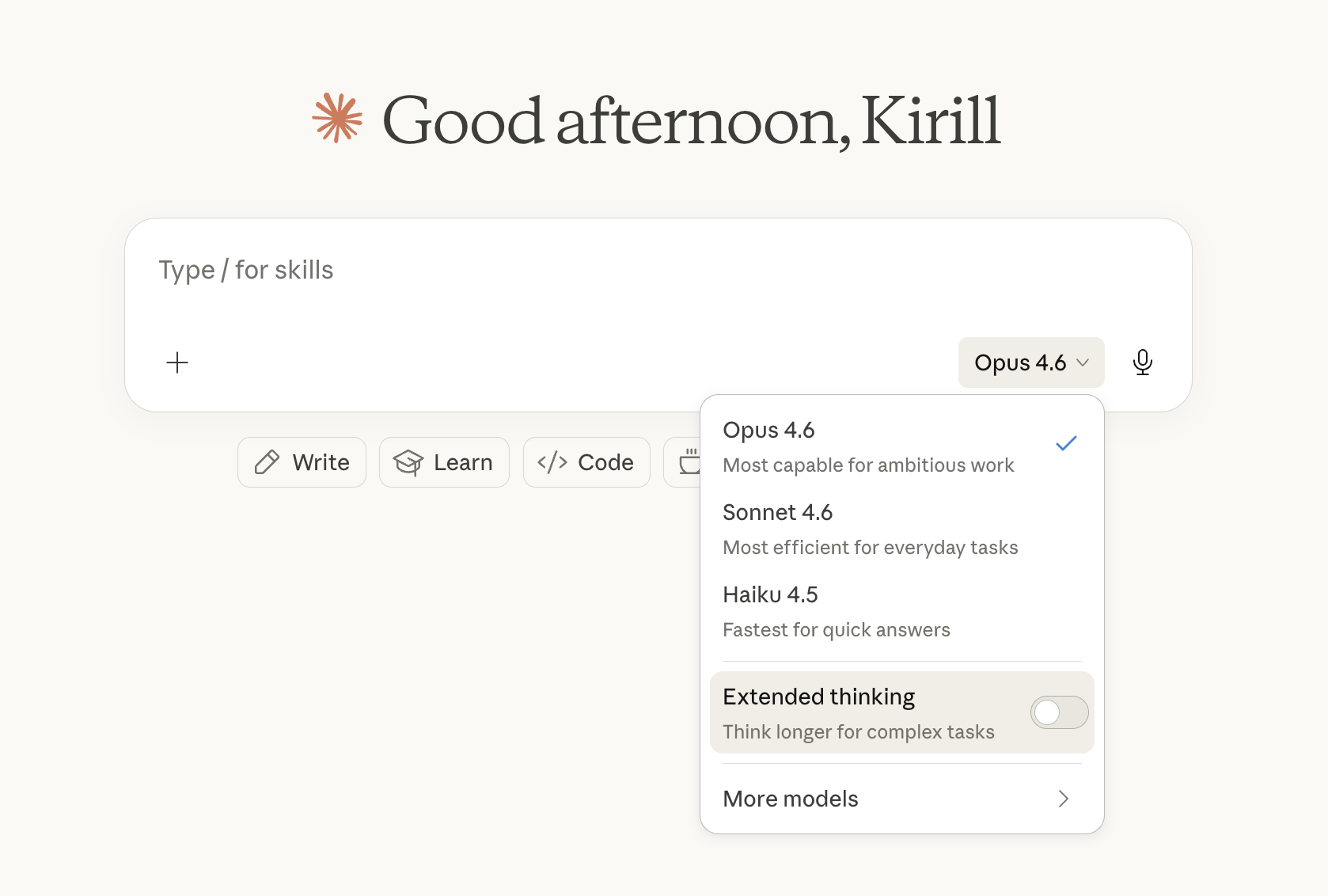
Several models are available in Claude
- Claude Opus — the most powerful model. The latest version, Opus 4.6, was released in February 2026. It’s suitable for scientific research, complex analysis, and agentic tasks. It can generate responses up to 128,000 tokens — that’s approximately 90,000 words in a single response. For comparison, GPT-5.2 and Gemini 3 Pro output a maximum of 65,000 tokens.
- Claude Sonnet — a balance between speed and quality. Version Sonnet 4.6 was released in February 2026. This is the “workhorse” for most tasks: writing texts, data analysis, and coding.
- Claude Haiku — the fastest model with a focus on instant response. Version Haiku 4.5 was released in October 2025. It’s used for content moderation, support chatbots, and tasks where speed matters more than depth of analysis.
All models support a context window of up to 1 million tokens — that’s approximately 750,000 words in English. You can upload an entire book into Claude, a financial report spanning several years, or a large software project, and it will work with the entire volume of information.
Claude’s knowledge base was last updated in August 2025. To get current information, you need to enable web search directly in the chat interface.
Claude vs. ChatGPT: Comparing Neural Networks
Comparing Claude and ChatGPT is one of the most common queries among neural network users. Both services solve similar tasks but approach them differently.

In some areas Claude is better, while in others ChatGPT leads
Context window. Claude accepts up to 1 million tokens as input — this is one of its main advantages. ChatGPT with GPT-5.2 works with a context of up to 128,000 tokens in standard mode. If you need to analyze large documents, Claude handles it better.
Response length. Claude Opus outputs up to 128,000 tokens per response, while ChatGPT outputs up to 65,000. This is critical for tasks requiring detailed analysis or large code segments.
Working with code. Claude Code is a full-fledged AI agent for developers that integrates into a project, works with local files, and independently makes changes. ChatGPT Codex offers similar functionality, but according to developer reviews, Claude Code works more accurately and better understands project context.
Text quality. Many users note that Claude’s texts sound more “human” and natural. ChatGPT often produces more formulaic phrasing, although the gap is gradually narrowing.
Image generation. Here ChatGPT has a clear advantage — the built-in DALL-E allows creating images directly in the chat, and the quality is quite good.
Ecosystem. ChatGPT offers the GPT Store with thousands of custom bots, voice mode, and deeper integration with mobile devices. Claude is simpler in features, but the ones it has work reliably.
Memory between dialogs. Both services can remember user preferences. But within a single long Claude chat, it retains context noticeably better — on the 50th page of a dialog, it remembers what was discussed at the beginning.
Claude vs. Gemini: What to Choose
Gemini from Google is another serious competitor to Claude. Here are the main differences:
Gemini stands out with its excellent Nano Banana Pro image generator
- Multimodality. Gemini was originally built as a multimodal model that works equally well with text, images, audio, and video. Claude can analyze images but doesn’t generate them and doesn’t work with video.
- Google integration. Gemini is deeply embedded in the Google ecosystem — Gmail, Docs, Sheets, Search. Claude also connects to Google Workspace, but this integration is less deep.
- Working with long documents. Both models support large context windows (Gemini — up to 2 million tokens in the Pro version), but Claude shows higher accuracy when searching for specific data in large text arrays.
- Code. Claude Code significantly surpasses Gemini’s capabilities for developers. Google offers Canvas and other tools, but Gemini hasn’t yet reached the level of a full-fledged AI coding agent.
- Availability in Russia. Both services are officially unavailable in Russia, but Gemini is somewhat easier to register for — it doesn’t require phone number verification through an app.
Capabilities and Features of the Claude Neural Network
Claude offers a set of tools that go beyond a regular chatbot. Here are the main capabilities: