In March, iPhone prices in Russia crept up again — and this isn’t a one-time spike. We decided to investigate what exactly is happening and asked ChatGPT: we fed it all the latest news about Dubai, Trump’s tariffs, and the memory shortage, then asked it to explain what will happen with prices next. If you’re thinking about whether to buy an iPhone right now, this conversation will help you make a decision.

So what will happen to cheap iPhones now?
Why iPhones Are Getting More Expensive in Russia — We Ask ChatGPT
First, we asked the neural network to explain the mechanics: why do events in the Middle East even affect iPhone prices in Russia? After all, Apple doesn’t manufacture anything there. Here’s what the AI responded:
After Apple left the Russian market, the main supply channel became parallel imports. Most of these supply chains went through Dubai: that’s where major electronics distributors are concentrated, with developed air logistics and convenient routes to Russia. In late February 2026, Dubai’s airport was damaged, major carriers suspended flights and cargo shipments through the region. Supplies didn’t disappear completely — there are routes through China and India — but the volume and delivery speed dropped. Sellers don’t know when the next batch will arrive or at what price, so they’re already building risks into the price tag.
We verified: that’s exactly what’s happening. The parallel import iPhone scheme through the UAE worked roughly like this: a shipment was assembled in Dubai, loaded onto a plane, and within a few hours it was already at a warehouse in Russia. Fast, predictable, without extra links. Now that link has been knocked out — and iPhone prices in Russia have already risen by an average of 15%. For example:
- back in January, you could buy an iPhone 17 Pro for 92–95 thousand rubles
- now you’ll have to pay over 100–110 thousand
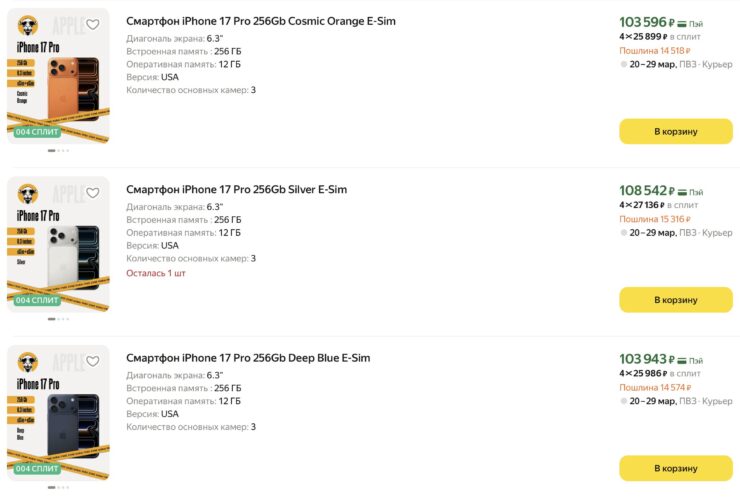
And with the tariff, it could be all 120K rubles
When Will iPhone Prices Drop — The Neural Network’s Answer
The next question on everyone’s mind: okay, Dubai shut down — but that’s temporary, right? They’ll reopen the airport and everything will go back to normal? The machine thinks otherwise:
Not quite. Prices are rising not because there’s no product — but because there’s uncertainty. Even when the route is restored, sellers won’t immediately bring prices back down: they’ve already gotten used to the new level and will maintain it as insurance. For prices to return to previous levels, stable supplies are needed for several weeks, or better yet — months. Plus the Dubai disruption is only one of three factors currently pushing up prices.
The three factors — that’s interesting. We asked for a breakdown of each and found out that the rise in iPhone prices worldwide, including in Russia, was the result of events far beyond what’s currently happening in the Middle East.
Trump’s Tariffs and iPhone — What ChatGPT Says
It turns out the foundation for the price increase was an entirely different story. Namely, it all started with new U.S. laws:
The second factor is American tariffs. On April 2, 2025, the Trump administration imposed tariffs on nearly all foreign goods. The countries hit hardest were those where Apple manufactures its products: Vietnam received a 46% tariff, China — 34%, India — 26%. This directly impacts production costs. Right now Apple faces a choice: absorb it from their margin or pass it on to the consumer.
We asked for clarification: these are American tariffs — why do they affect Russia?
Russia isn’t directly in the zone of the American trade war. But the global cost of iPhone production is rising — and this drives up the base cost of the device for any market. If the iPhone 18 launches more expensive than the iPhone 17, it will automatically push prices up on all previous models: sellers won’t keep the 16 and 17 at old price tags when the new flagship costs more.
After the president’s threats, Apple’s stock price dropped nearly 4%. The company even considered raising prices on all iPhone 17 models — explaining it with new features and design, though the real reason is obvious to everyone. However, the iPhone 17 Pro price remained unchanged. Incidentally, analysts predict that the iPhone 18 Pro will also keep its price, despite featuring the most significant changes.
Memory Shortage and Apple Product Prices
The third factor is the least obvious one. We asked ChatGPT: what is the memory shortage and why does it affect iPhones? The neural network’s answer is perfectly simple and clear:
For several years, Apple locked in purchase prices for memory chips through long-term contracts with manufacturers. This allowed them to keep device costs stable even when the market was turbulent. Now these contracts are coming to an end, and new ones are being signed at market prices — which have risen noticeably due to the global shortage. Apple is holding back for now, but the reserves will eventually run out.

Memory is the second most important component after the processor. Image: appleinsider.com
This is also confirmed by our colleagues: Android smartphones are already getting more expensive due to the memory shortage — and Apple is next in line. By our estimates, by fall 2026, Apple product prices could rise by a quarter or more.
iPhone Price Forecast for April 2026 — ChatGPT’s Summary
At the end, we asked the neural network to combine all three factors into a specific forecast. An important disclaimer: ChatGPT calculated based on the data we provided — it’s not an analyst or an oracle, but as a calculator for combining factors, it did the job. Here’s the final answer:
If you sum up all three factors — the logistics disruption through the UAE, rising production costs due to tariffs, and the expiration of memory contracts — iPhone prices in Russia in April 2026 will most likely be 10–20% higher than at the beginning of the year. If the situation in the Middle East stabilizes within the next 2–3 weeks, the increase may slow down. If not — a further jump of 5–10% is possible. The tariff and memory factors aren’t going anywhere regardless of Dubai.
We cross-checked this forecast with actual prices on marketplaces: over February–March, prices have already shifted by 10–15%, meaning the lower bound of the forecast is already materializing. Here’s what the picture looks like at the beginning of March and where prices could go by April:
| Model | Current Price (March 2026) | April Forecast |
|---|---|---|
| iPhone 17 (128 GB) | ~75,000 ₽ | ~82,000–88,000 ₽ |
| iPhone Air | ~89,000 ₽ | ~98,000–105,000 ₽ |
| iPhone 17 Pro (256 GB) | ~108,000 ₽ | ~118,000–125,000 ₽ |
| iPhone 17 Pro Max | ~123,000 ₽ | ~133,000–140,000 ₽ |
Due to all of this, a price increase for all Apple subscription services in Russia is also expected — VAT, exchange rates, and new pricing benchmarks are doing their thing.
In short, April promises to be uncomfortable for those who were planning to buy an iPhone at a good price. If you need a smartphone — it’s better not to wait.