Photographing the lidar sensor on a new car from close up, especially with zoom, can damage your smartphone’s camera sensor. According to Russian reports, phone repair services have seen a rise in damaged cameras, and the reports blame lidars, the driver-assistance sensors fitted to some new Chinese cars. The risk appears low in everyday situations, and a few simple precautions reduce it further.
What you need to know
- The Telegram channel Baza, as reported by Rossiyskaya Gazeta, says requests to repair damaged smartphone cameras rose by 30% over a year. It attributes the increase to lidars on new Chinese cars.
- According to Baza, repairs cost at least 15,000–20,000 rubles.
- Volvo’s manual for the EX90 tells owners not to point a camera, including a smartphone camera, at the lidar, according to SlashGear.
- A repair technician told BFM that his service had not yet seen such cases, because the lidar beam moves constantly.
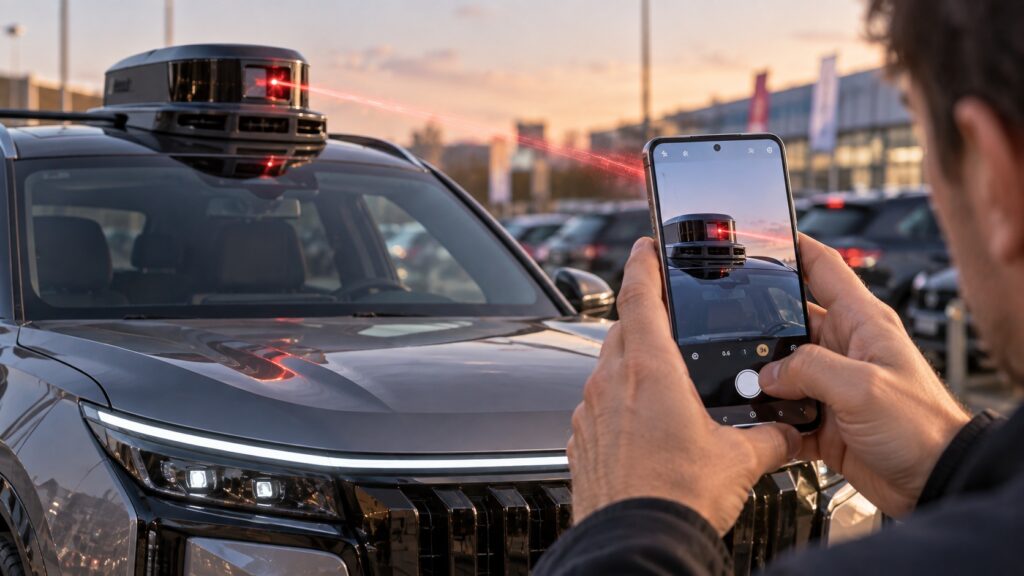
A car’s lidar scanner hitting a smartphone camera
What happened
The Telegram channel Baza reported a 30% year-on-year increase in requests to repair damaged smartphone cameras, as summarized by Rossiyskaya Gazeta. According to the report, repairs cost at least 15,000–20,000 rubles. It blames lidars, the sensors used by driver-assistance systems on new Chinese cars.
How lidar can harm a camera sensor
A lidar emits laser pulses in the infrared range. These are invisible to the human eye, but a camera sensor can pick them up. The source explains that shooting an active sensor at close range can let the laser burn out some of the camera’s pixels. Zoom is the most dangerous case, because a telephoto lens concentrates the beam into a small point.
How serious is the risk?
Manufacturers acknowledge the risk. Volvo’s EX90 manual explicitly warns against pointing a camera, including a smartphone camera, at the car’s lidar, SlashGear reports. The source adds that Apple also warns lidars can damage a phone’s camera sensor even when the Camera app is closed. The source author says Android smartphones are built the same way.

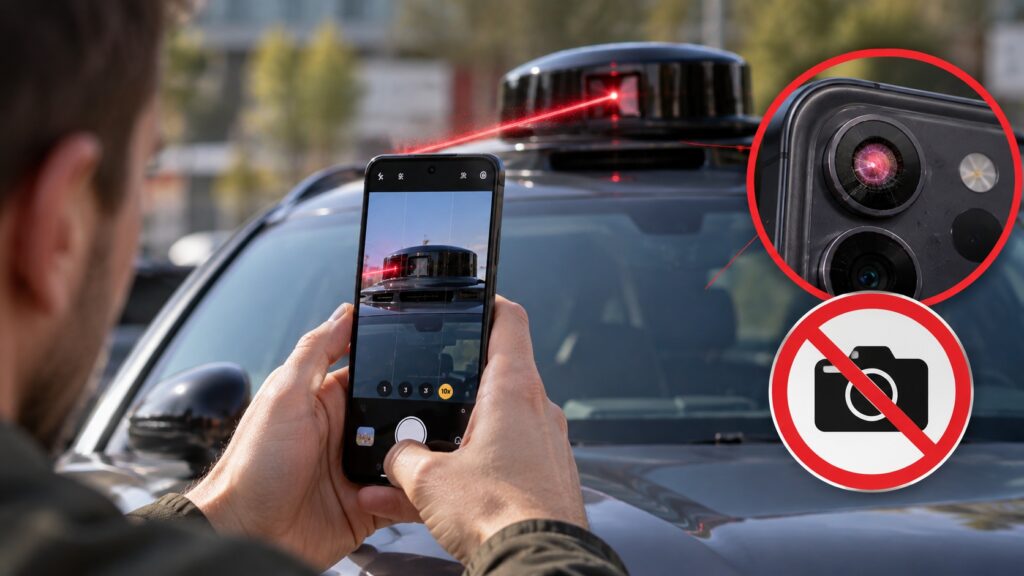
Visualization of the risk a lidar scanner poses to a smartphone
Not everyone agrees on how common the problem is. A repair technician speaking to BFM said his service had not yet received any such cases. He explained that the lidar beam moves constantly, so you would have to aim deliberately at the sensor to damage a camera. Based on this, the source concludes that walking past such a car or photographing it from a distance is almost safe. The risk arises when you shoot the sensor itself up close, especially with zoom.
Which cars were named in the reports
According to Baza, most of the complaints in Russia involve these brands:
- Lixiang (Li Auto)
- Xiaomi
- Geely
- Zeekr
Not every car from these brands has a lidar. It is fitted only to versions with advanced driver-assistance features. On the Li L6, L7, L8 and L9 in Pro versions, and on the Xiaomi SU7 in Pro and Max versions, the lidar sits on the roof above the windshield. The source says it is easy to recognize: a small bump or “turret” at the top of the windshield.

How to tell if your camera sensor is damaged
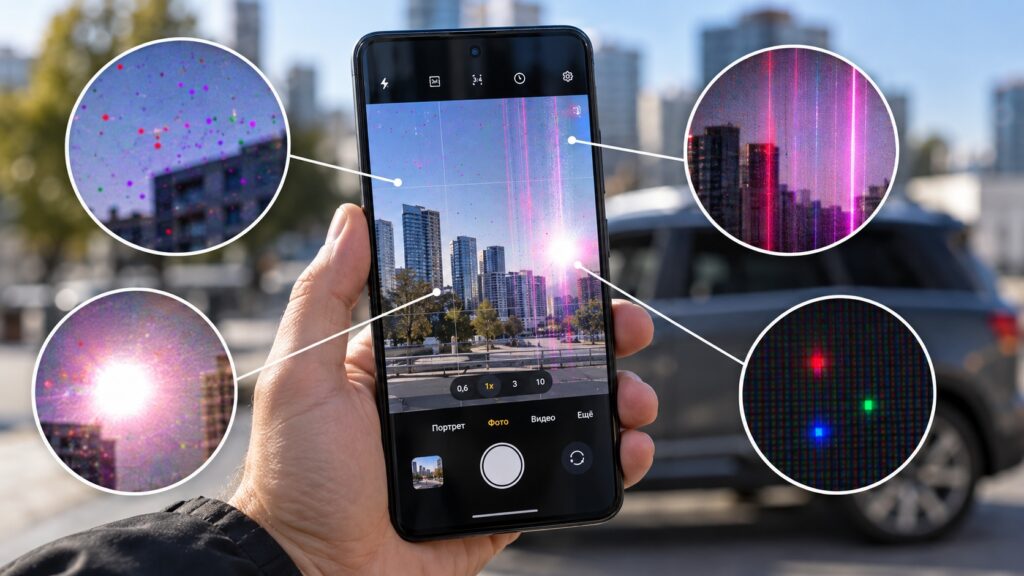
Signs of sensor damage after exposure to a lidar
Laser damage does not go away after restarting the phone or switching to another camera app. The source lists these symptoms in photos and videos:
- colored dots, most often red, pink or purple;
- lines and bright spots;
- a flickering image;
- individual dead pixels.
The simplest check is to point the camera at a plain surface, such as a white wall or a dark ceiling. According to the source, if the dots appear in the same place in every frame, the sensor is damaged rather than the lens being dirty.
How to avoid damage
The source calls the threat real but says the chance of accidentally ruining a camera is low. To reduce it further, it recommends a few simple rules:
- do not photograph a roof-mounted lidar at close range;
- do not use zoom when an active sensor is in the frame;
- photograph these cars from several meters away and from the side, not head-on and up close.
The source also notes that this kind of damage is usually classed as external damage, so owners should not count on warranty repair. A few seconds of caution costs far less than a replacement camera module.