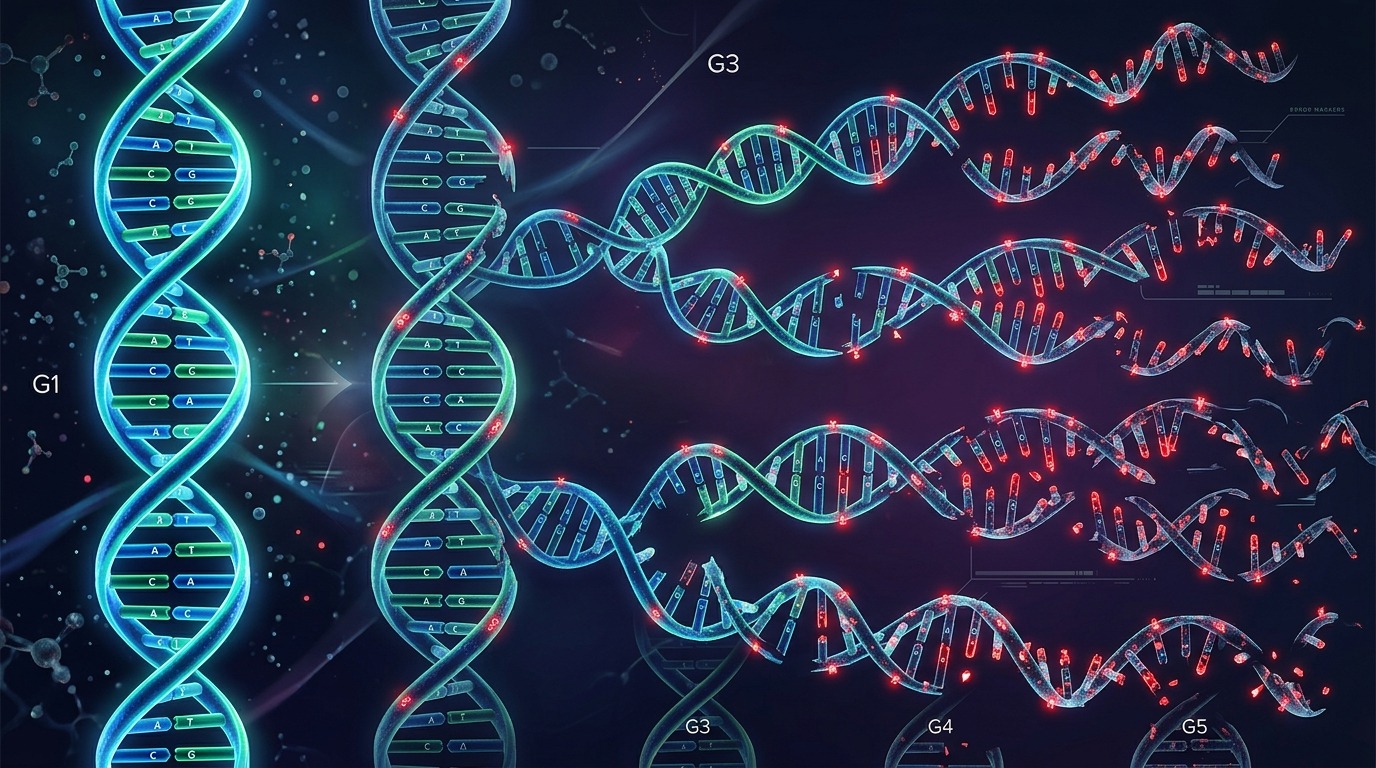
Schematic illustration of mutation accumulation in DNA during serial cloning.
Japanese scientists spent 20 years creating clones from clones of a single mouse — and discovered that this process has a hard limit. By the 58th generation, the pups died on the very first day after birth. The study, published in Nature Communications, experimentally demonstrated for the first time that mammals cannot sustain their species through cloning alone. And this serves as yet another reason why scientists have still not cloned a human.
How Scientists Cloned Mice for 20 Years
The experiment began in 2005 at the University of Yamanashi (Japan) under the leadership of geneticist Sayaka Wakayama. The scientists took one female mouse and cloned her using somatic cell nuclear transfer — the very same method that brought the famous Dolly the sheep into the world in 1996. The concept is simple: the egg cell’s own nucleus with its DNA is removed and replaced with a nucleus from a regular body cell of the donor. The result is an embryo genetically identical to the donor.
But the Japanese team didn’t stop at one clone (nor at 600 clones of one mouse). They took the cloned mouse, waited for it to reach three months of age, and then cloned it. Then — they cloned the clone of the clone. And so on, every three to four months, over the course of two decades. During this time, more than 30,000 cloning attempts were made and more than 1,200 mice were produced from a single original donor.
In essence, the scientists were testing a simple question: Can you copy a copy infinitely? Or does the genetic “photocopier” have a precision limit?
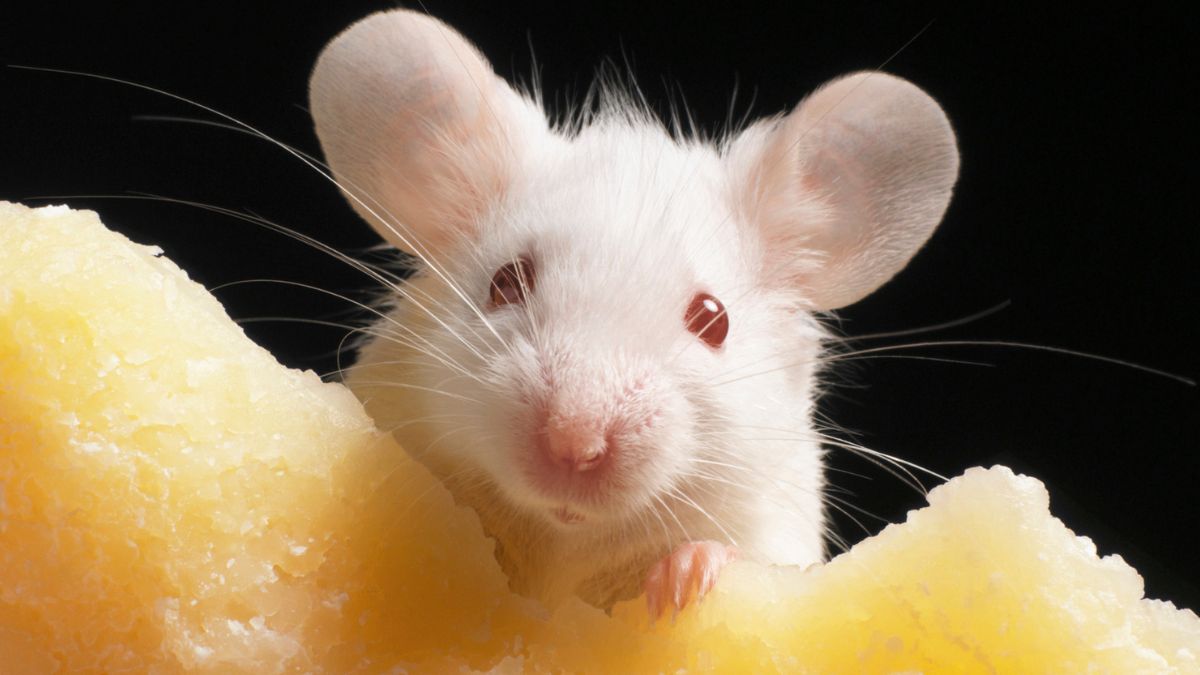
Laboratory mice — the main participants in the 20-year serial cloning experiment. Image source: sciencealert.com
Why the First Generations of Clones Were Healthy
The initial results were encouraging. For 25 generations, cloned mice were indistinguishable from the original: they were healthy, lived as long as regular mice (about two years), and could even reproduce. Moreover, the success rate of cloning was increasing — from an initial 7% to 15.5% by the 26th generation.
The team used a special reagent — trichostatin A — which suppresses mutation activity during the cloning process. It helped maintain the efficiency of the procedure even in later generations. At first, the scientists believed that serial cloning could continue indefinitely. But this impression turned out to be deceptive. Beneath the outwardly normal appearance, problems were already accumulating — they simply weren’t yet visible to the naked eye.
What Mutations Appear During Cloning
To understand what was happening at the DNA level, the scientists sequenced the genomes (“read” the DNA chains and searched for mutations) of ten clones from different generations. The results were telling: clones carried three times more mutations than mice born through normal sexual reproduction.
With each new round of cloning, the genome acquired approximately 70 small point mutations (substitutions of individual DNA “letters”) and about 1.5 large structural changes. Individually, this isn’t critical, but the problem is that during cloning, all mutations are passed on to the next generation in their entirety. A clone has no mechanism that could “filter out” defective genes — unlike sexual reproduction, where the genome is reshuffled with each conception.
Imagine you’re copying a document on a photocopier. The first copy is nearly perfect. But if you copy the copy, and then copy the copy of the copy — with each iteration the quality drops, and defects only multiply. This is exactly how the study authors themselves described the process. Starting from the 27th generation, mice began to develop serious chromosomal abnormalities — in particular, one of the two X chromosomes was lost. The placentas of clones became abnormally enlarged.
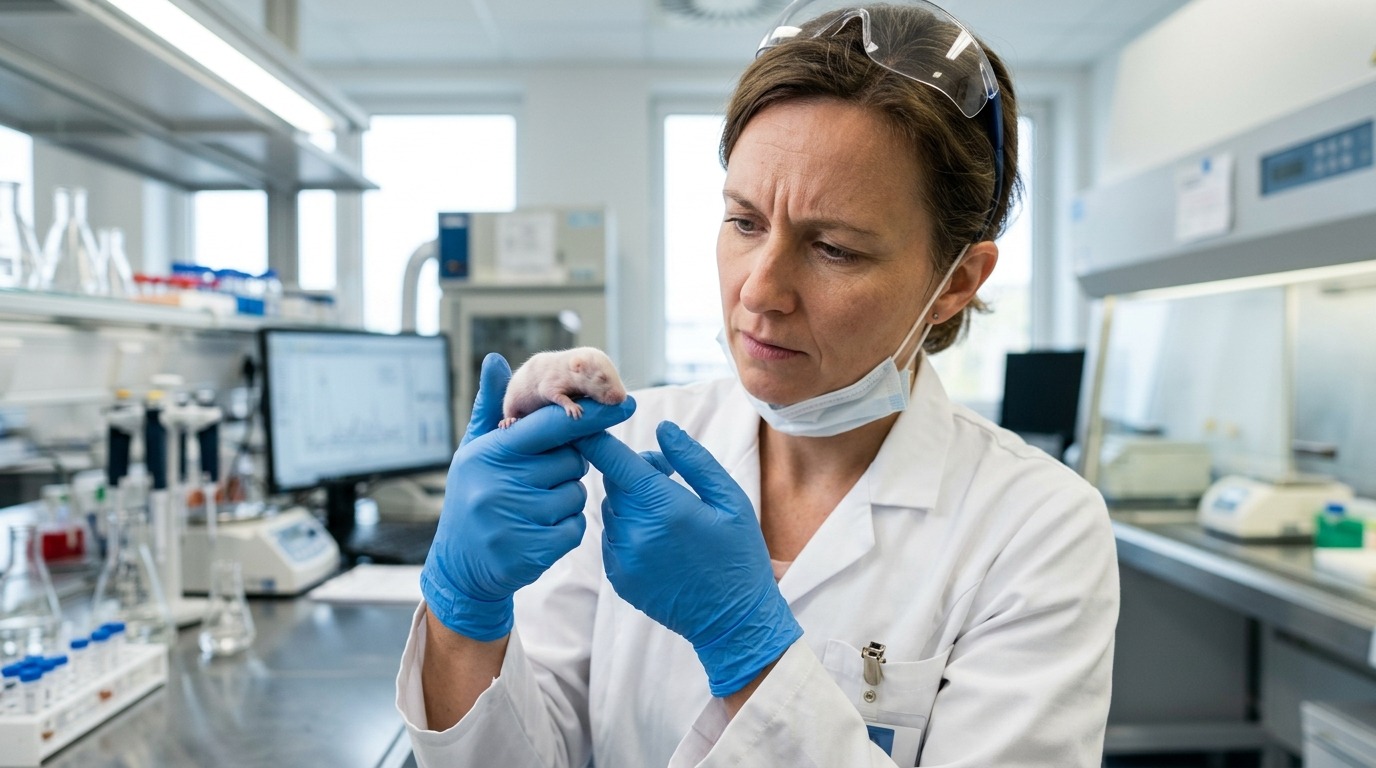
Pups of the 58th generation died on their first day of life with no visible external abnormalities.
Muller’s Ratchet: Why Clones Degenerate
The results of the Japanese experiment became the first experimental confirmation in mammals of a long-standing evolutionary hypothesis — the so-called “Muller’s ratchet.” This idea was proposed by American geneticist Hermann Muller back in 1964.
The concept is simple: in an asexual population, harmful mutations can only accumulate but never disappear. A ratchet is a mechanism that turns in only one direction. The same applies to mutations: without sexual reproduction and genetic reshuffling, it’s impossible to “roll back” damage. Sooner or later, the mutational burden becomes incompatible with life — a state that biologists call “mutational meltdown.”
This is exactly what happened with the mice. By the 57th generation, only 0.6% of clones survived — but those that survived were still healthy and lived a normal lifespan. However, the 58th generation was the last: all pups died within 24 hours of birth. Notably, they showed no visible physical abnormalities.
“We believed that we could create an infinite number of clones. That is precisely why these results are so disappointing,” admitted project leader Teruhiko Wakayama.
Why Sexual Reproduction Cleanses DNA and Is Irreplaceable for Mammals
One of the most interesting parts of the study was the attempt to rescue the genetic line through ordinary sexual reproduction. The scientists crossed cloned females from the 20th, 50th, and 55th generations with normal males.
Clones from the 20th generation produced normal litters. The 50th and 55th generation clones had significantly smaller litters — the mutational burden was already interfering with normal embryo development. However, already in the grandchildren of these clones — that is, when their offspring were crossed again with normal mice — litter sizes returned to normal. Sexual reproduction literally “repaired” the damaged genome within just one to two generations.
This is a key finding: during sexual reproduction, recombination occurs — a reshuffling of genes from two parents. Thanks to this process, harmful mutations can be “cleaned out” by natural selection. Cloning lacks this mechanism, and therefore genetic errors only accumulate.
Why Cloning Cannot Replace Natural Reproduction
The results of this study have direct implications for several fields in which cloning was considered a promising tool. Some conservationists had hoped that serial cloning could help save endangered species from extinction or resurrect extinct animals. Some companies already offer cloning of pets. But the Japanese experiment demonstrated: cloning cannot replace sexual reproduction for the long-term preservation of a species.
Key takeaways from the study:
- Single-instance cloning still works — clones from the first generations are healthy and viable.
- Serial cloning (clone from clone) inevitably leads to mutation accumulation and degeneration of the lineage.
- Sexual reproduction can compensate for the genetic damage caused by cloning within just one to two generations.
- The idea of a “genetic vault” from which a species can be endlessly reproduced through cloning alone is currently unrealizable.