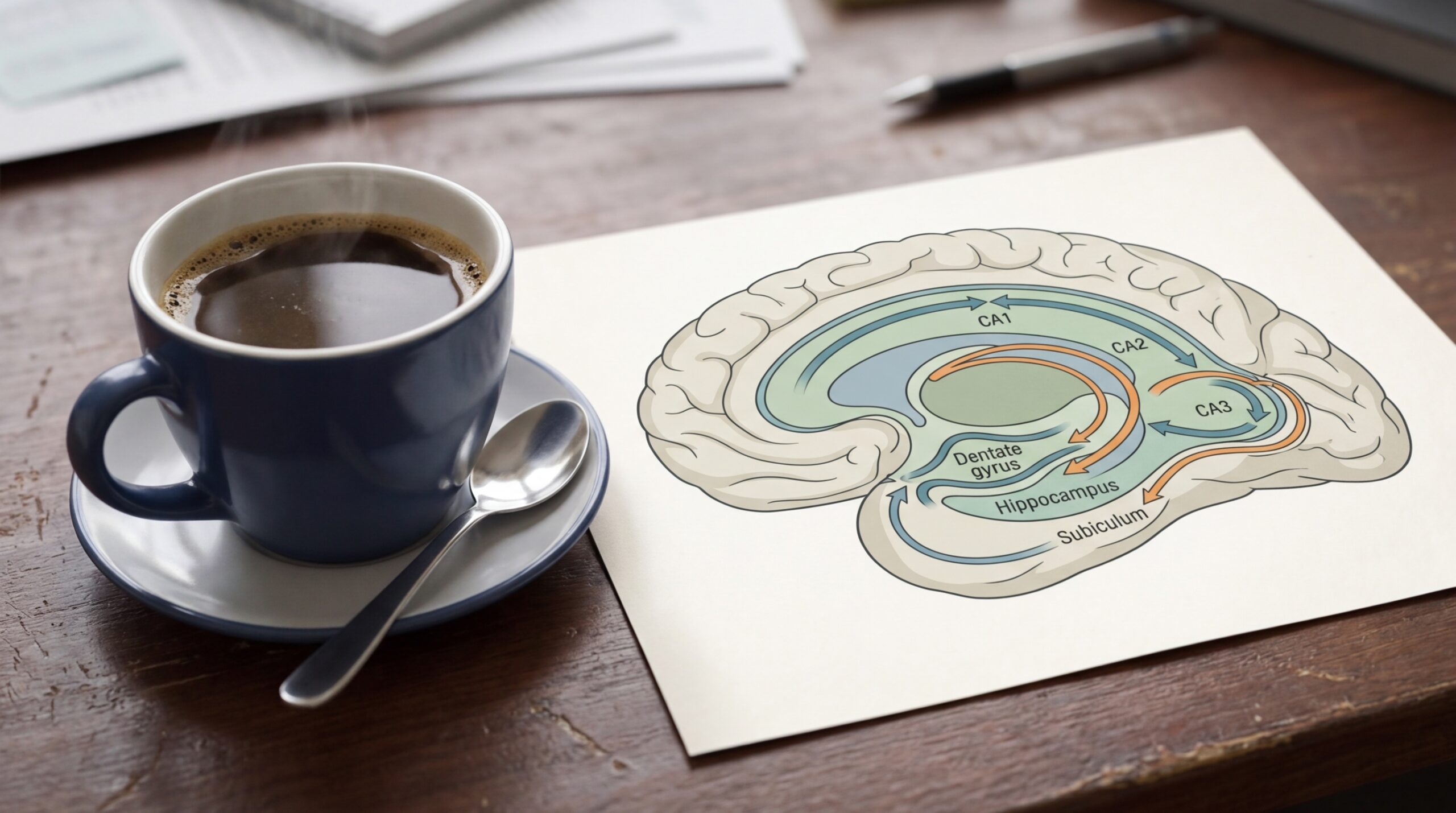
Caffeine blocks adenosine receptors — the molecular mechanism through which it protects memory.
Sleep deprivation hits memory hard — everyone who has ever forgotten a colleague’s name or lost their train of thought after a sleepless night knows this. And it’s no coincidence: the brain truly works differently when we suddenly forget everything on the go. But a new study from the National University of Singapore revealed something unexpected: caffeine doesn’t just help you wake up — it can literally restore memory circuits in the brain that were damaged by sleep deprivation. Though so far — only in mice.
How Sleep Deprivation Destroys Social Memory
When we talk about memory, we most often think of memorizing facts or events. But there’s another type — social memory. It’s the ability to recognize familiar people, recall details of past encounters, and distinguish a new person from someone you’ve already met. This type of memory is one of the first to suffer from sleep deprivation, despite being the least studied.
Researchers from Singapore focused on a specific brain region — the CA2 area of the hippocampus. The hippocampus is a structure without which the formation of new memories is impossible, and the CA2 area plays a key role specifically in recognizing social contacts. In the experiment, mice were deliberately deprived of sleep and then tested to see if they could recognize a fellow mouse they had already met. The result was predictable: sleep-deprived mice recognized familiar individuals significantly worse.
“Sleep deprivation is not just fatigue,” explains physiologist Lik-Wei Wong from the National University of Singapore. — “It selectively disrupts the function of critical memory circuits.” In other words, the brain doesn’t simply “slow down” — it loses the ability to perform specific tasks.

Caffeine may restore memory after its loss due to sleep deprivation and insomnia. However, this hasn’t been tested on humans yet. Image source: sciencealert.com
How Caffeine Affects the Brain and Memory After Insomnia
The most interesting part of the study is what happened when caffeine was added to the experiment. One group of mice was given stable doses of caffeine for a week before sleep deprivation. And when the test came, these mice showed no decline in social memory — unlike those that didn’t receive caffeine.
But the second result turned out to be even more surprising. When caffeine was applied to brain tissue taken from sleep-deprived mice, signals in the CA2 area improved even without prior caffeine intake. In other words, the substance worked both as prevention and as a “repair” for already damaged connections.
The mechanism turned out to be linked to adenosine — a chemical substance that accumulates in the brain during wakefulness and causes sleepiness. During sleep deprivation, the level of adenosine signaling in the brain increases, and this, as previous studies have shown, suppresses the function of circuits responsible for forming memories. Caffeine is a well-known blocker of adenosine receptors. Imagine that adenosine is a brake pedal for memory, and caffeine prevents it from being pressed.
Why the CA2 Area of the Hippocampus Is So Important for Memory
Before this study, the link between sleep deprivation and social memory was poorly understood. Scientists knew that sleep is critically important for memory consolidation (the process by which short-term memories are converted into long-term ones), but which specific brain areas are affected and how — remained unclear. This new work is the first to show in detail that the CA2 area is a kind of “hub station” connecting sleep and social memory.
“Our results position the CA2 region as a critically important node between sleep and social memory,” says neuroscientist Sreedharan Bhatt Sajikumar.
This is important not only for fundamental science. Social memory impairments are among the early symptoms of dementia and Alzheimer’s disease. If researchers can precisely understand how sleep deprivation damages this area and how caffeine restores it, this could provide new targets for medications.
Can Caffeine Restore Memory After Insomnia and Reduce the Risk of Dementia
The link between regular coffee consumption and a reduced risk of dementia has been noted in epidemiological studies before. But until now, the exact mechanism behind this was unclear. The new study offers a specific explanation: caffeine may protect social memory circuits in the hippocampus by blocking excessive adenosine signaling that builds up during chronic sleep deprivation.

Regular coffee consumption is linked to a reduced risk of dementia, and now this connection has a molecular explanation
In dementia, memory impairments often begin precisely in the social sphere — a person stops recognizing acquaintances, confuses faces, and forgets the context of conversations. If these impairments are at least partially caused by the same adenosine pathways that are affected by sleep deprivation, then caffeine — or drugs based on it — could theoretically slow this process.
But an important caveat is needed here. This study was conducted on mice. Although the biology of rodents and humans overlaps in many ways, the results cannot be directly transferred. Caffeine dosages, sleep patterns, and the complexity of human social memory — all of this could significantly affect the outcome. The authors explicitly state that clinical studies involving humans are needed.
What Has Been Proven and What Remains a Hypothesis
For clarity, it’s worth separating the results into what has already been confirmed by this work and what remains an assumption:
- Confirmed in mice: sleep deprivation disrupts signals in the CA2 area of the hippocampus and impairs social memory.
- Confirmed in mice: caffeine taken in advance prevents this disruption.
- Confirmed in brain tissue: caffeine can restore signals in CA2 even after the fact.
- Hypothesis: a similar mechanism works in humans.
- Hypothesis: regular caffeine consumption may protect against cognitive impairments associated with chronic sleep deprivation and dementia.
The study was published in the peer-reviewed journal Neuropsychopharmacology, which speaks to a serious level of data verification. But from a mouse experiment to practical recommendations is a long road. Nevertheless, the work is valuable because it is the first to precisely identify a specific brain area and a specific molecular pathway through which sleep deprivation destroys social memory and caffeine restores it.
This isn’t simply “coffee is good for the brain” — it’s a map with coordinates that will help scientists search for new ways to combat the consequences of chronic sleep deprivation and, possibly, dementia. And if further research confirms these results in humans, your morning cup of coffee may turn out to be something much more than just a habit.