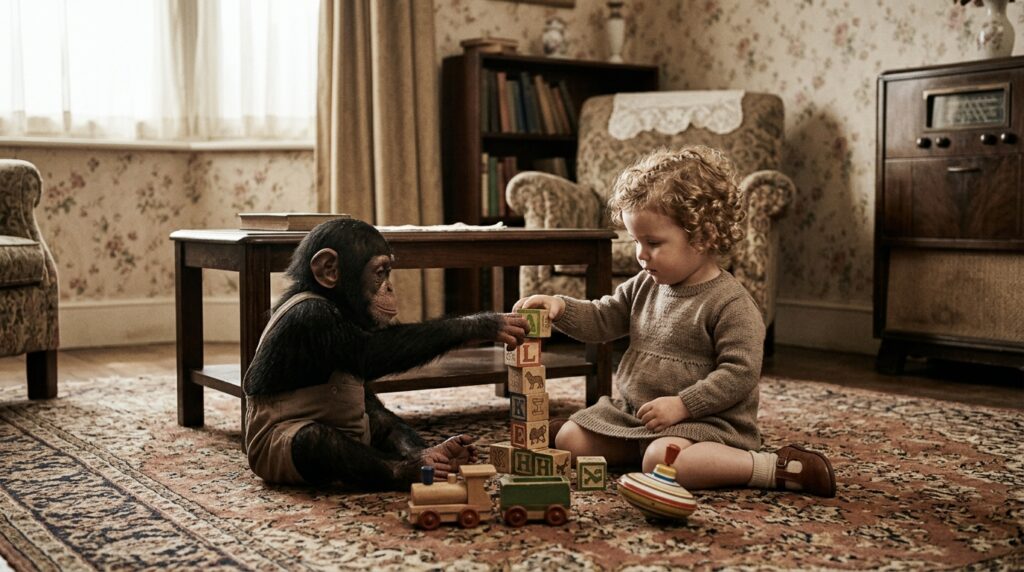
A toddler and a baby chimpanzee playing with blocks in a living room
No one has yet managed to teach an ape to speak out loud the way humans do. That does not mean apes cannot communicate. Great apes have learned hundreds of gestures and symbols, using them to ask for food and to name objects and actions. Some have even put together simple phrases. Still, what they produce cannot be called human language. Here is why, and what scientists have actually learned.
What you need to know
- Chimpanzees raised alongside humans in the 20th century learned at most a few words, which they pronounced with great difficulty.
- A 2016 X-ray study of living macaques suggested their vocal tract could, with good control, produce a range of distinct speech-like sounds, pointing to the brain rather than anatomy as the main barrier.
- Apes taught sign language or symbol boards learned hundreds of signs, but analyses of the chimpanzee Nim and the bonobo Kanzi showed their utterances mostly consisted of a single sign.
- Studies of wild chimpanzees (2022) and bonobos (2025) found non-random call sequences, and in bonobos, combinations whose meaning depends on both signals.
Chimpanzees raised among people never started talking
The first attempts began in the early 20th century. American researcher William Furness spent a great deal of time training an orangutan, which learned to produce something resembling a couple of simple words. To get the English word “cup,” the animal’s tongue had to be placed in the right position by hand. Results with chimpanzees were even worse.
In the 1930s, Winthrop and Luella Kellogg raised a chimpanzee named Gua together with their son, Donald. Gua understood many things said to her and in some everyday tasks even outperformed the boy. But at around 16 months Donald began to talk, while Gua never did. The experiment was halted once it became clear that the child had started imitating the chimpanzee’s sounds.
In the 1940s and 1950s, Keith and Catherine Hayes raised a chimpanzee named Viki for several years, almost as a daughter. She helped around the house, copied people’s actions and even imitated how they used cosmetics. Yet after years of lessons she had only a handful of words, pronounced with enormous effort: “mama,” “papa” and “cup.” In other words, the ape could copy human actions but almost none of human speech.
A macaque’s mouth could handle speech, but the brain gets in the way
For a long time, the explanation was thought to be anatomical: the larynx and vocal tract of monkeys and apes are built differently, so they simply cannot produce the necessary sounds. In 2016, an international team of scientists used X-ray imaging to record how the tongue, lips and larynx of living macaques move as they vocalize. From these data, they used a computer model to estimate which sounds such a vocal apparatus could produce in principle. The result: with good control, a macaque could produce a whole set of distinguishable speech-like sounds.
The main obstacle, it seems, lies in the brain. Saying even a word like “banana” requires coordinating breathing, voice, lips, jaw and tongue within fractions of a second, in a strict order. Humans do this at will: we decide to say a word and say it. In monkeys and apes, calls are mostly tied to emotions such as fear, excitement, food or conflict. Producing a particular sound simply because they want to is very difficult for them. This is currently one of the leading explanations for why apes do not talk.
Gestures and symbols worked much better
Since voice did not work, researchers turned to the hands. Allen and Beatrix Gardner taught a chimpanzee named Washoe American Sign Language, communicating with her in signs not only during lessons but in everyday life. According to the researchers, Washoe learned hundreds of signs, extended familiar signs to new, similar objects and combined signs with one another. In the best-known episode, on seeing a swan for the first time, she reportedly signed “water” and “bird.”
Koko, whom psychologist Francine Patterson worked with, became the most famous gorilla of all. The project’s authors said Koko knew about a thousand signs. However, she never mastered full grammar. Such experiments also have a long-recognized weakness: a person who knows the animal well may unconsciously cue the answer with a glance or posture. It is therefore more accurate to say that Koko used a large set of human signs than that she had language.
One of the most convincing cases was Kanzi, a bonobo. He communicated using a board of abstract symbols: one meant “banana,” another “go,” and so on. Kanzi knew more than 300 of these symbols and understood many spoken phrases, including unusual requests that could not have been memorized in advance. Researchers had not even set out to teach him: they were working with his adoptive mother, and he sat nearby and figured out how the system worked on his own. This reflects one of the basic properties of language: a symbol can stand in for an object or action.
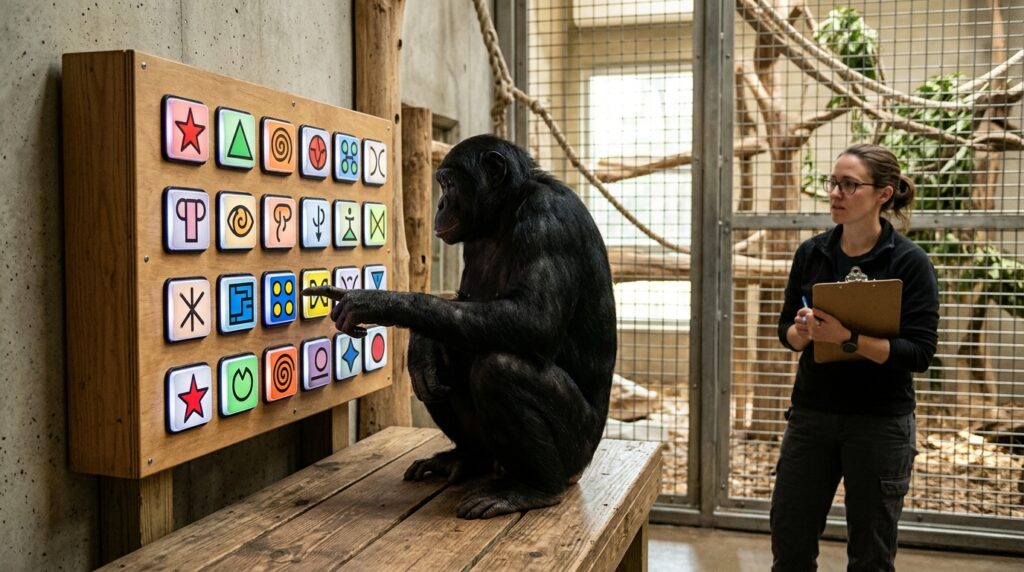
An ape presses colored symbols on a board while a researcher watches
Ape “sentences” barely grow
A two-year-old child quickly moves from single words to phrases like “mommy give” and “kitty sleeps,” and then their sentences rapidly become more complex. Trained apes show no such leap. When researchers analyzed the utterances of Nim, a chimpanzee, and Kanzi the bonobo, they found that most of the time they used a single sign, less often two, and only rarely longer strings. Extra signs usually just repeated or reinforced what had already been said.
An adult trained ape resembles a small child in some ways, but the child keeps developing quickly while the ape soon hits a ceiling. It will never learn to describe what happened yesterday or discuss plans for the week. Even so, calling all of this circus-style training would be unfair: apes apply signs in new situations and make requests of people on their own initiative.
Wild chimpanzees and bonobos string sounds together
In the wild, apes communicate in more complex ways than simply calling out “danger!” or “food!” In 2022, scientists analyzed nearly 5,000 vocal sequences from wild chimpanzees. Around ten basic sounds were combined into different sequences of up to ten elements, and their order was not random. However, the researchers could not say what most of these combinations mean.
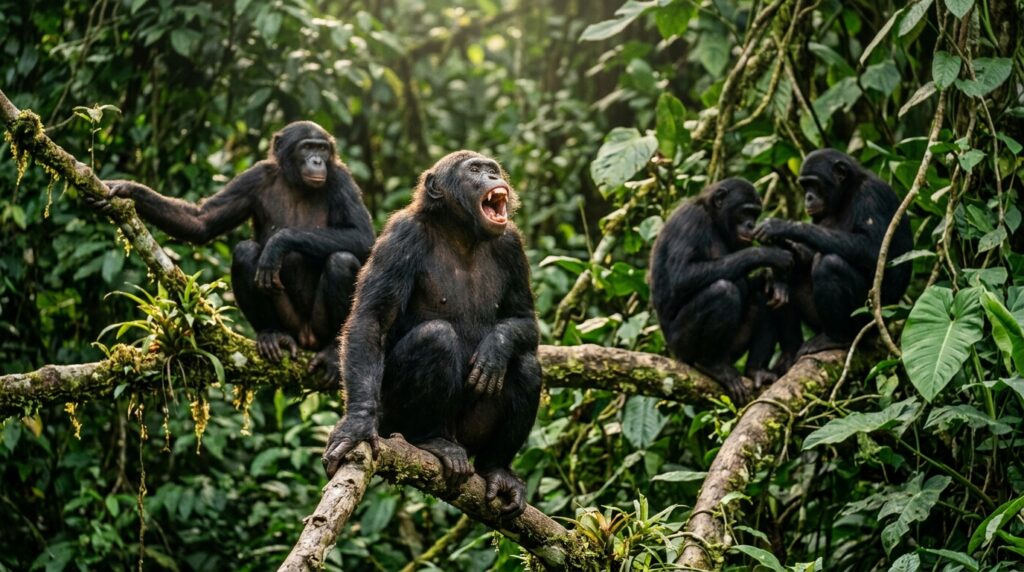
A group of primates on branches in a tropical forest
In 2025, the journal Science published a study of wild bonobos in Congo. The researchers analyzed 992 of their “utterances” and identified 12 basic call types. The meaning of some combinations was built from the meanings of both signals, and sometimes one signal changed the meaning of the other. Before this, there was almost no reliable evidence of such combinations outside human language. The authors themselves stress, however, that bonobos do not have human language: no huge vocabulary, no complex grammar and no talk about the past or the future.
The bottom line
In short, we do not know how to teach an ape to speak like a human, but teaching one to communicate with people through gestures and symbols is quite possible. In addition, some of the building blocks of language, such as meaningful gestures and combinations of signals, appear to have emerged before human speech.