Scientists outsmarted pure sound enthusiasts using an ordinary banana
Imagine: you spent several hundred dollars on an oxygen-free copper audio cable with gold-plated connectors, sat down in your chair, put on your headphones, and are enjoying the “crystal clarity of the sound.” Now imagine that someone secretly replaced your cable with an ordinary banana. Literally — a yellow fruit from the grocery store. And you didn’t notice any difference. That’s exactly what happened during a recent blind test, the results of which blew up audiophile forums around the world.
What Is a Blind Audio Test and Why Is There a Banana
Blind tests are the gold standard for verifying any subjective perceptions. The concept is simple: participants listen to music through different cables but don’t know which specific cable is connected at any given moment. This eliminates the placebo effect and bias — because if you know you’re listening through a $500 cable, the brain helpfully “improves” the sound.
In the experiment in question, a group of audiophiles was asked to compare several connection options: expensive premium-class cables, ordinary budget wires, and — attention — a real banana plugged into a “banana plug” connector (yes, these connectors are actually called that). The fruit wasn’t used as a joke but to demonstrate that any conductor capable of completing a circuit can transmit an audio signal. A banana contains enough moisture and electrolytes to conduct electrical current. Not perfectly, of course, but quite sufficient for transmitting an analog audio signal.
The result was discouraging for fans of expensive audio equipment. Test participants couldn’t consistently identify where the expensive cable was playing versus where the cheap one — or even the fruit — was connected. Statistically, their answers were no different from random guessing.
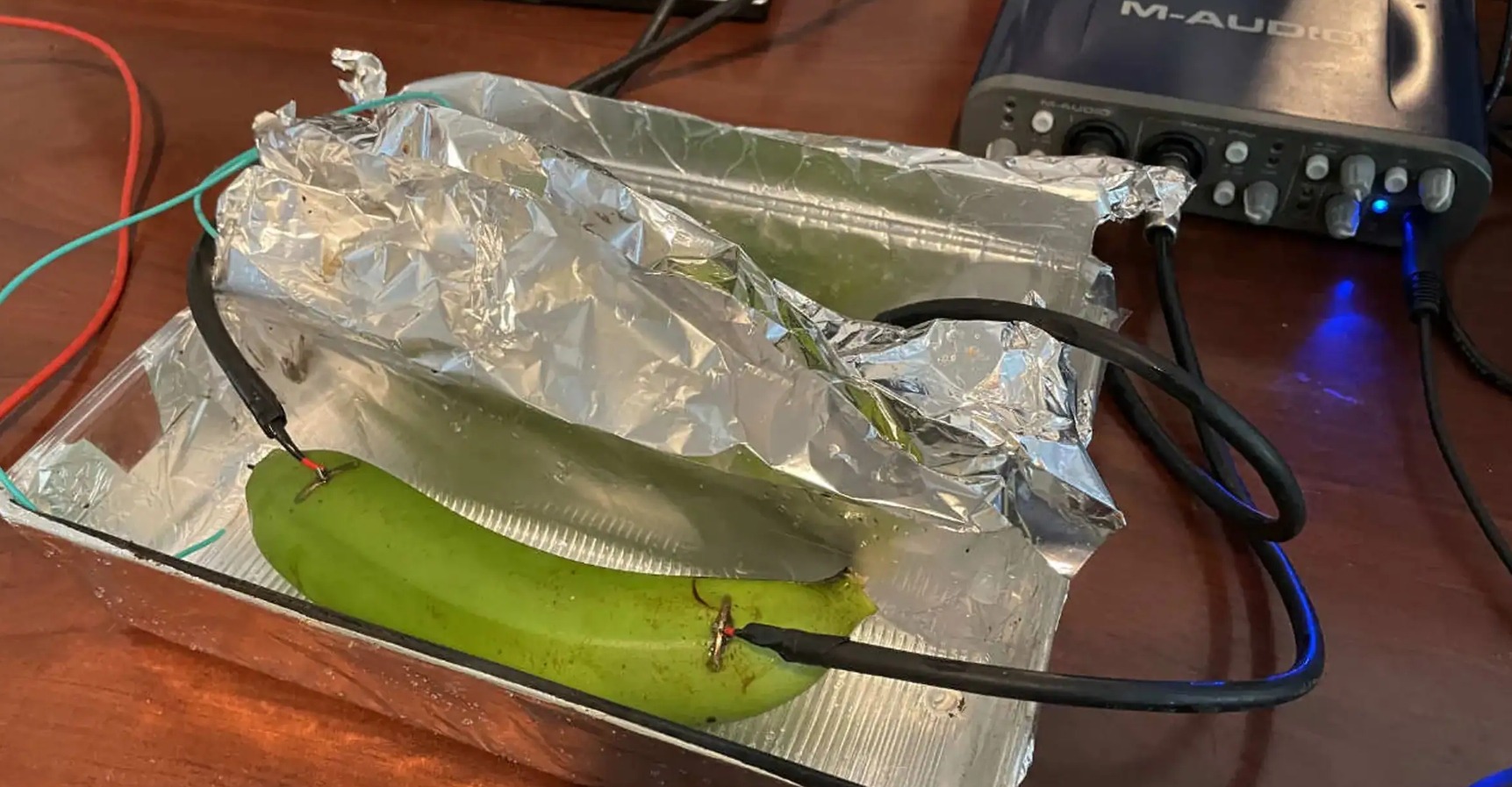
The banana plug got its name from its shape, but in this test everything was literal. The fruit performed no worse than a $500 cable. Image source: zmescience.com
Why Expensive Audio Cables Don’t Improve Sound
To understand why a banana “sounds” no worse than a premium cable, you need to understand a bit of physics. The audio signal traveling from an amplifier to speakers is a low-frequency electrical current (from 20 Hz to 20 kHz). At such frequencies and with typical conductor lengths (usually 1–3 meters), the difference in cable materials has virtually no effect on signal quality.
The fact is that the speakers themselves, room acoustics, and recording quality have a much greater impact on sound. A cable is simply a conductor, and as long as its resistance stays within reasonable limits, the sound doesn’t change. The difference between a cheap and an expensive cable is on the order of thousandths of a decibel. The human ear cannot distinguish that.
Manufacturers of expensive cables naturally disagree. They point to special conductor geometry, specialized insulation materials, and protection from electromagnetic interference. All of this sounds convincing, but blind tests show the same thing time and again: people can’t hear the difference. That said, this doesn’t stop the audiophile cable market from thriving. By various estimates, its volume is hundreds of millions of dollars per year.
What Is the Placebo Effect in Audio and How Does It Work
If there’s no difference, why do thousands of audiophiles swear they hear improvement after buying an expensive cable? The answer is simple — the placebo effect, and in audio it is incredibly powerful.
When a person spends a large sum, the brain automatically seeks confirmation that the purchase was justified. This is called the cognitive bias known as “effort justification.” You paid $500 — so the sound simply must be better. And the brain obediently “hears” deeper bass, clearer highs, and a wider soundstage.
Furthermore, expectations shape perception. Numerous neuroscience studies show that visual and contextual information directly affects auditory perception. If you’re told this cable is better — you’ll hear it as better. Simply put, we listen to music not only with our ears but also with our brains. And the brain is an impressionable thing.
This effect has been well studied in other fields as well. For example, in famous wine tastings, participants consistently rated cheap wine higher when the bottle had an expensive label. Exactly the same thing happens with audio.
Is It Worth Spending Money on Audio Cables at All
Does all of this mean you should immediately throw away all your cables and connect speakers through vegetables and fruits? No. A banana as a conductor is more of a dramatic demonstration than a practical solution. It will quickly dry out, oxidize, and stop conducting current.
But here’s what really deserves attention: the difference between a $5 and a $500 cable is purely marketing. An ordinary copper cable of appropriate gauge (for most home systems, that’s 1.5–2.5 mm²) will do just as well. The main thing is that the contacts are reliable and the wire isn’t damaged.
If you want to genuinely improve sound, it’s better to invest in acoustic room treatment, quality speakers, or a good DAC (digital-to-analog converter). These investments will yield an audible result, unlike replacing a cable with a more expensive one.
This test once again proved a simple truth: in the world of audio, marketing often beats physics. But once you close your eyes and just listen, the truth comes out. Even if that truth smells like a banana.