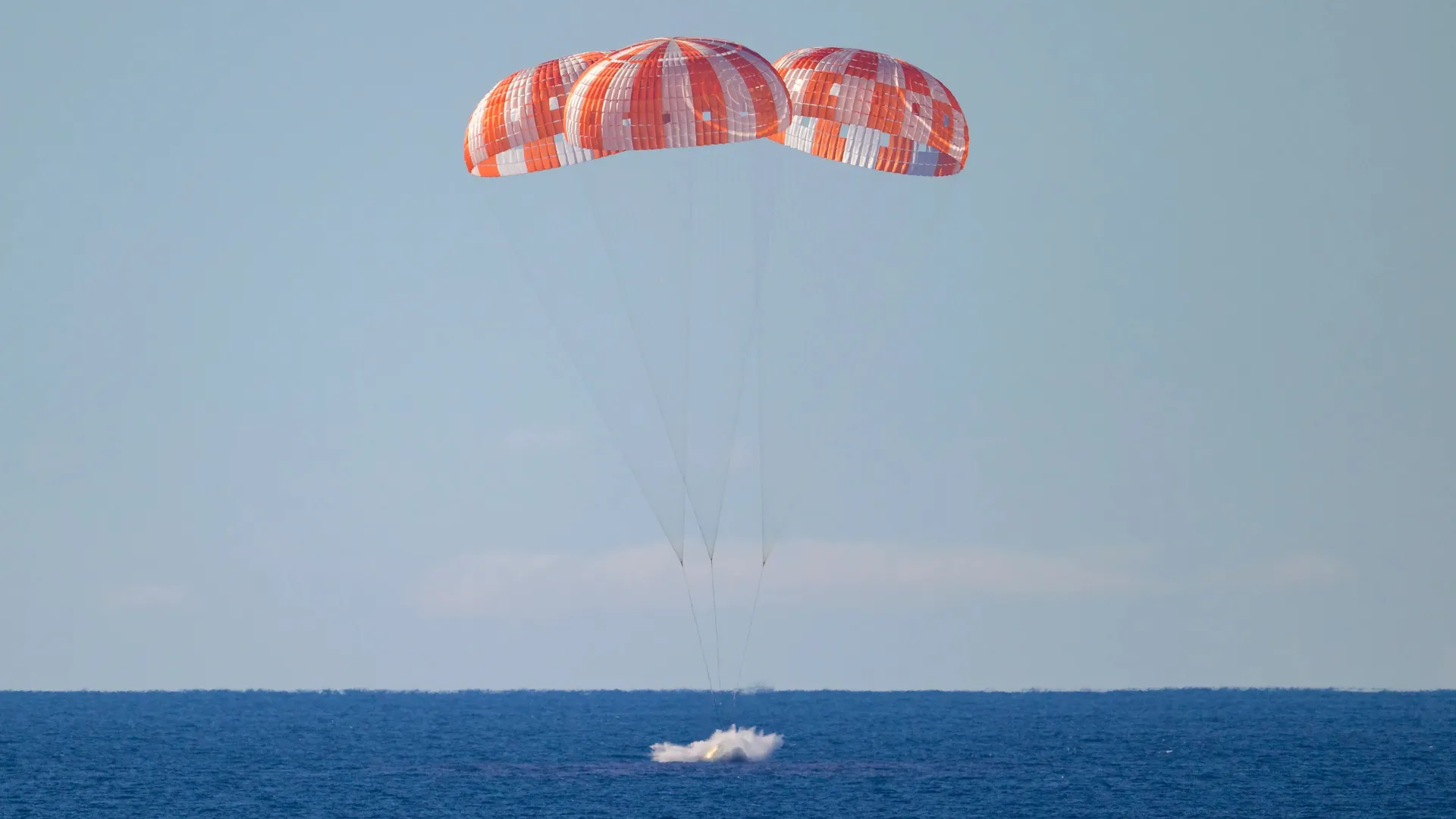
The Orion capsule splashes down in the Pacific Ocean after returning from the Moon
The Orion spacecraft from the Artemis 2 program has returned to Earth after a 10-day mission to the Moon. This was the first crewed flight beyond low Earth orbit in more than half a century. The capsule splashed down in the Pacific Ocean, and NASA called the landing a “bullseye.” Atmospheric reentry at a speed of approximately 39,600 km/h was one of the most intense phases of the mission — and one of the most successful.
NASA astronauts returned from the Moon
Returning from the Moon is nothing like descending from the International Space Station. The ISS orbits in low Earth orbit, just 400 kilometers from the surface. From there, a capsule enters the atmosphere at a relatively “modest” speed. But Orion was traveling on a lunar trajectory and slammed into the atmosphere at approximately 39,600 km/h — about 11 kilometers per second.
To put that in perspective: that’s roughly 24 times faster than a bullet. At that speed, the capsule’s heat shield experienced twice the thermal load compared to a return from the ISS. The temperature on the shield’s surface reached approximately 2,760 degrees Celsius — about half the temperature of the Sun’s surface.
According to Live Science, communication with the spacecraft was completely lost for six minutes — the capsule was enveloped in a cloud of superheated plasma through which radio signals cannot pass. This is a standard but always tense part of any reentry. When Orion reappeared on radar, already under parachutes against a nearly cloudless sky, applause erupted in Mission Control.
Why Artemis chose a direct atmospheric entry
An interesting detail: the atmospheric entry trajectory for Artemis 2 differed from the uncrewed Artemis 1 mission, which took place in 2022. Back then, Orion used a so-called “skip entry” — the capsule bounced off the upper layers of the atmosphere once, like a stone skipping off water, before plunging deeper. This distributes the thermal load and allows for more precise landing site selection.
But after Artemis 1, engineers had concerns about the heat shield — its condition after the flight raised questions. So for the crewed mission, NASA chose a more direct entry trajectory. This meant the shield experienced the load over a shorter period, but engineers had a better understanding of how it would behave. The decision proved correct: the shield performed nominally throughout.
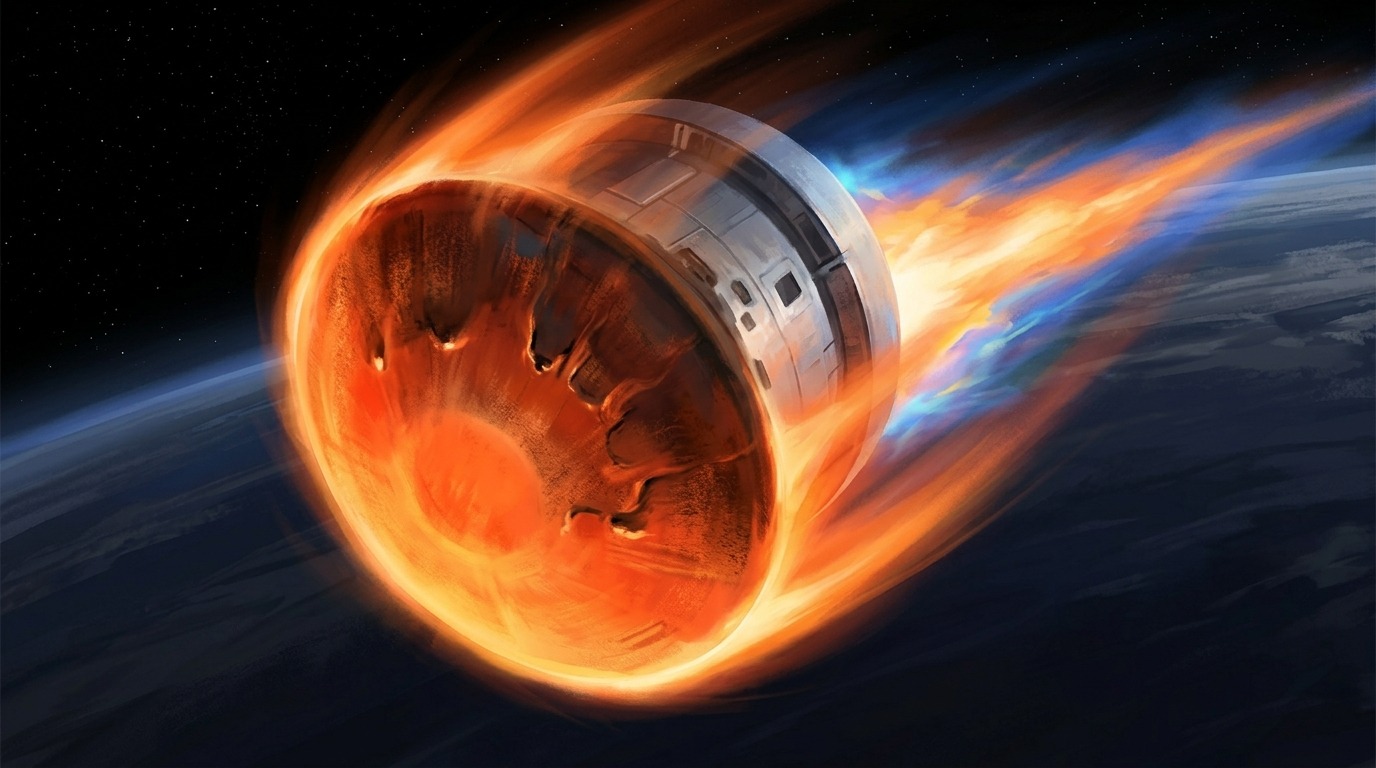
This is what Orion’s atmospheric entry looks like: the heat shield heats up to nearly 2,800 degrees Celsius
Specifications of the Orion spacecraft
Orion is a crewed spacecraft developed by NASA in partnership with Lockheed Martin specifically for flights beyond low Earth orbit. It is fundamentally different from the spacecraft that fly to the ISS. Here’s what’s important to understand about its design:
- Heat shield — the largest ever built for a crewed spacecraft. Designed for return at lunar speeds, not orbital ones;
- The capsule is designed for a crew of up to four people and autonomous missions lasting up to 21 days;
- For landing, it uses ocean splashdown, just like in the Apollo era. After splashdown, the crew is met by a U.S. Navy vessel: astronauts are lifted onto an inflatable platform and then evacuated by helicopter.
The heat shield was one of the main points of intrigue for the mission. After Artemis 1, engineers discovered that it had not behaved entirely as expected. This forced the team to reconsider the entry trajectory for Artemis 2. That makes the result all the more valuable: all systems performed nominally, and the landing was so precise that NASA called it a bullseye.
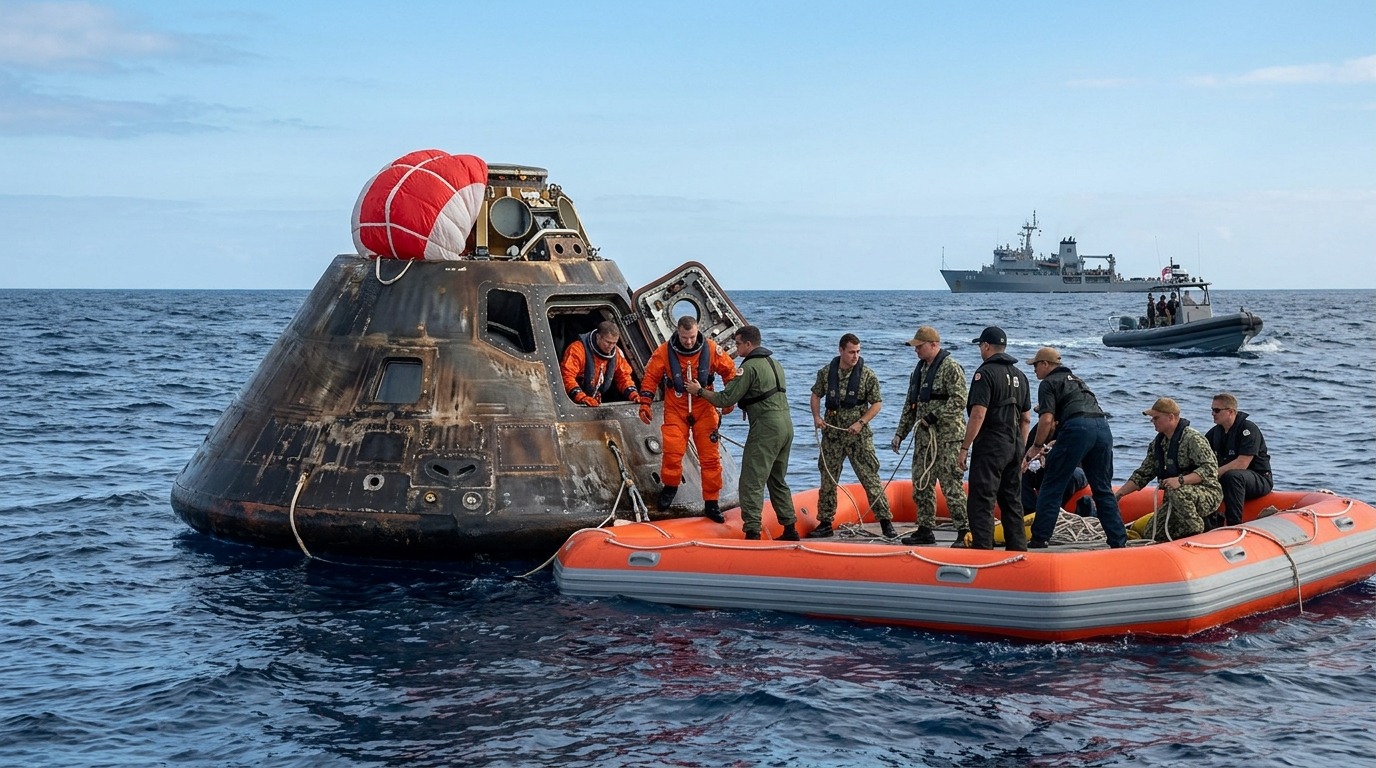
Navy crew helps astronauts transfer to an inflatable platform after splashdown
What’s next for the Artemis program
Artemis 2 was a verification mission. The crew did not land on the Moon — the goal was to confirm that the Orion spacecraft and all its life support, navigation, and thermal protection systems work with people on board just as reliably as they did without them. That verification has been passed.
The next step is Artemis 3, a mission with a landing on the lunar surface. It will require not only Orion but also a lunar lander (being developed by SpaceX based on Starship). Exact timelines have not been announced yet, but the success of Artemis 2 makes that next step significantly more realistic.
The ten-day flight has concluded — and it proved the most important thing: the technologies that took years and billions of dollars to develop actually work. The heat shield held up. The life support systems performed. The landing was flawless. For the first time in half a century, humans flew to the Moon and returned home — and now the road to the lunar surface is a little wider than it was yesterday.