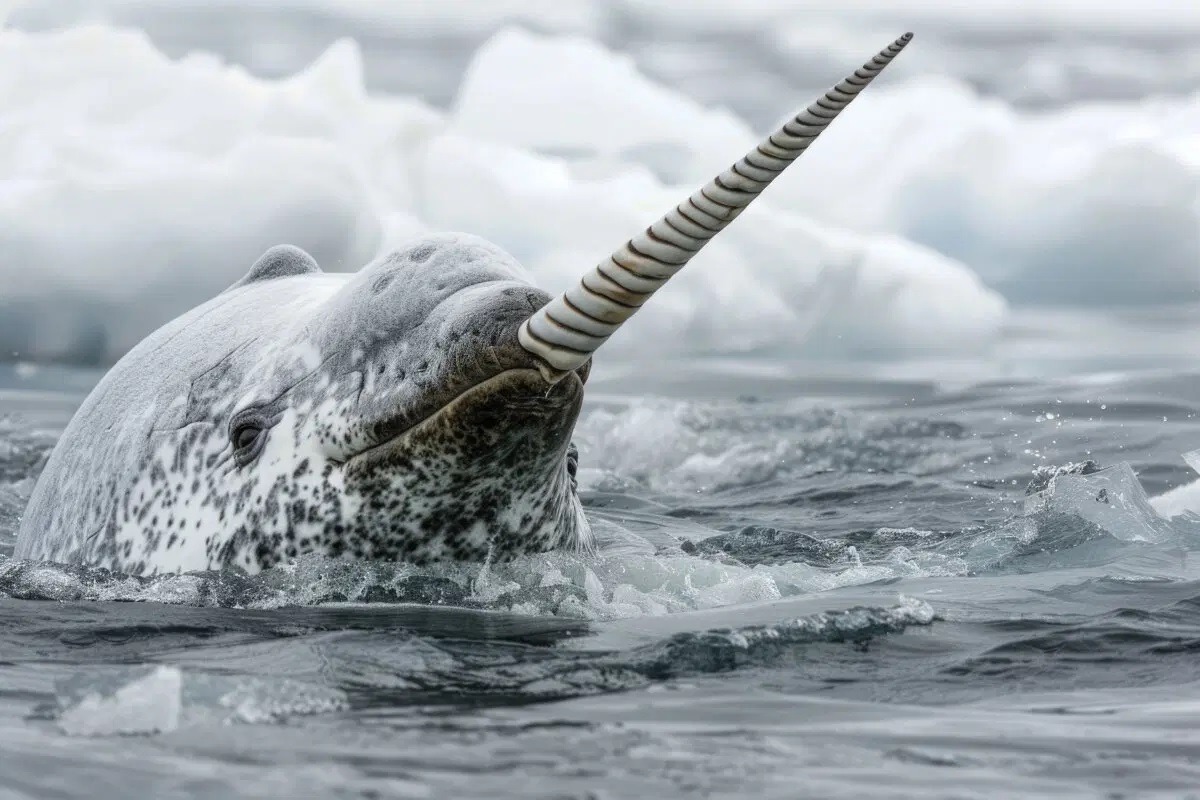
Narwhals and their tusk: is it true that the ‘unicorn horn’ is only needed for mating? Image source: vombat.su
If the myth of the unicorn had been born in the Arctic, the narwhal would be its hero. The narwhal is not just a symbol of the North, but one of the most mysterious inhabitants of the Arctic Ocean. This whale truly sports a “horn”—a long spiral tooth that can grow to nearly three meters. For a long time, it was believed that the tusk was mainly needed for battles over females. But modern research using drones has shown that its functions are much broader.
Where Narwhals Live and What They Look Like
The narwhal (Monodon monoceros) is a member of the monodontid family, a relative of the beluga whale. It inhabits the Atlantic part of the Arctic—from Greenland and Canada to eastern Russia.
In winter, it stays among pack ice (floating sea ice), using cracks and polynyas, and in summer moves closer to the coast.
These whales have a robust body, a small head without a pronounced “beak,” and no dorsal fin—which helps them maneuver under the ice. Males reach 4.8 meters and weigh up to 1,600 kilograms. They live up to 50 years and make annual migrations following the ice and their prey.

These social whales typically stay in groups of two to ten individuals, but they are quite elusive and difficult to study in the wild. Image source: wwf.org.uk
How Narwhals Use Their Tusks for Mating, Hunting, and Communication
The main feature is the left upper tooth of males, which at 2–3 years begins to grow outward and spirals to the left (left-handed spiral). It can grow up to 3 meters in length.
Initially, it was considered a “weapon” for competing over females. Males do indeed “cross” tusks—probably demonstrating strength and status. But observations published in the journal Frontiers in Marine Science revealed new functions. Narwhals are capable of:
- stunning fish with precise strikes of the tusk tip;
- examining objects and tracking prey;
- displaying playful behavior;
- interacting with fellow narwhals without aggression.
The tusk is connected to the circulatory system and is permeated with sensitive channels, so it functions as a sensory organ, responding to changes in water temperature and salinity.

According to new data, narwhals may use their tusks to search for food, explore their environment, and even for play. Image source: lifestyle.znews.vn
What the Narwhal Tusk Reveals About Arctic Climate
Another unexpected role of the tusk is storing ecological history. Its layers grow gradually, like tree rings.
Analysis of carbon and nitrogen isotopes showed that since the 1960s, the narwhals’ diet has changed along with the reduction of sea ice. And mercury levels in their tissues after the 1990s rose faster than expected—likely due to a combination of warming and pollution.
Thus, the narwhal is not only a symbol of the Arctic but also a living indicator of climate change. Its “horn” turned out to be not just nature’s decoration, but a complex survival tool and a source of data about the North.