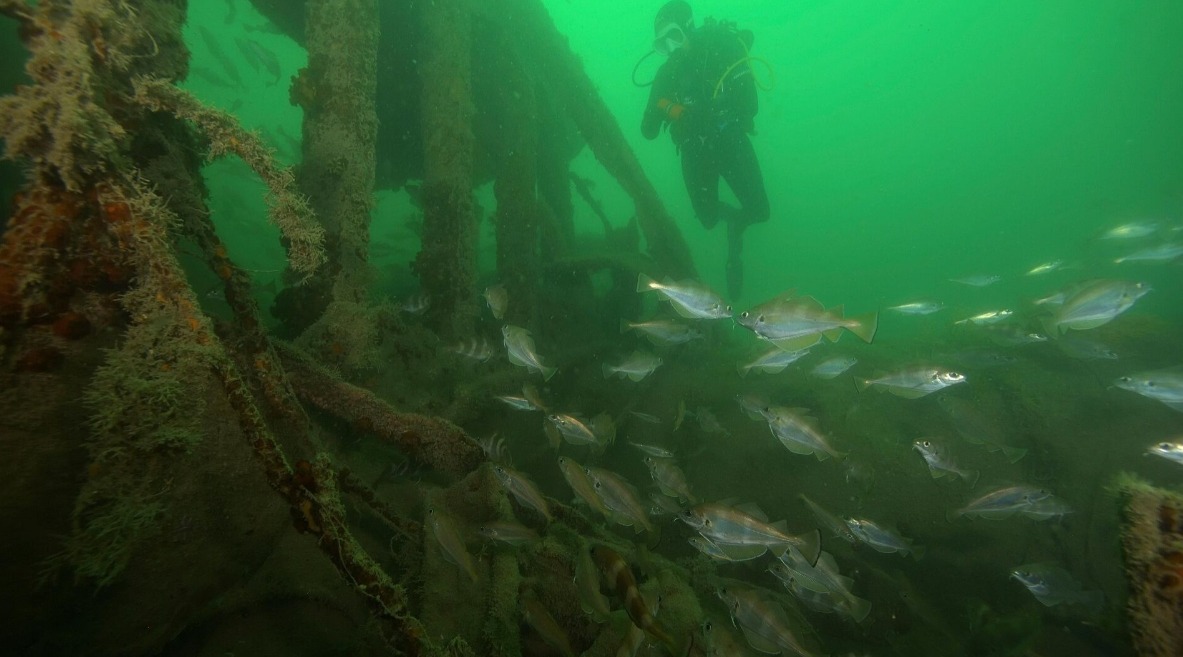
Near Libya, scientists found many ancient artifacts. Image source: interestingengineering.com
When a ship sinks, it takes with it not only cargo but also the stories of entire eras. Off the coast of northeastern Libya, on a stretch of seabed about 100 meters long, archaeologists discovered a cluster of ancient shipwrecks near a city that is over 2,300 years old. The most intriguing part — the vessels most likely didn’t sink all at once but over centuries, repeatedly failing to dock at the same treacherous shore.
Scientists Discovered a New Ship Graveyard
After a 12-year hiatus caused by civil war, archaeologists from the University of Warsaw returned to the ancient Greek city of Ptolemais in 2023. Research unfolded simultaneously on land and underwater, and the results exceeded all expectations.
Approximately four kilometers from the coast, scientists noticed a scattering of amphoras — ancient Greek vessels used for transporting wine and oil — in the shallows. The amphoras became a kind of “trail of breadcrumbs”: they led archaeologists to cargo fragments, ship rigging, and finally the ship wreckage itself. According to Dr. Piotr Jaworski, the expedition leader, the countless shipwrecks were the most impressive find. Most likely, vessels over centuries encountered the same treacherous conditions while trying to enter the port, and time after time they failed.
But that’s not all. Among the finds was a bronze aequipondium — a movable counterweight from Roman scales. It was filled with lead and shaped like a woman’s head. And in one of the recovered amphoras, crystallized wine was discovered, which is now being studied in a laboratory.
The Sunken Port of Ptolemais
In 2024–2025, underwater archaeologists identified extensions of port structures: traces of columns, submerged roads, ship anchors, and depth-measuring instruments. All these finds point to the existence of a large-scale port complex that went underwater due to rising sea levels and seismic activity.
Ptolemais was one of the largest Greek cities in the Cyrenaica region. It was founded between the 4th and 3rd centuries BCE by kings of Egypt’s Ptolemaic dynasty. The city thrived for centuries and fell only during the Arab conquest in the 7th century CE. For comparison, the area of its ruins today covers approximately 280 hectares — the size of a small European town. The city is not built over by modern buildings, making it a true gift for archaeologists.
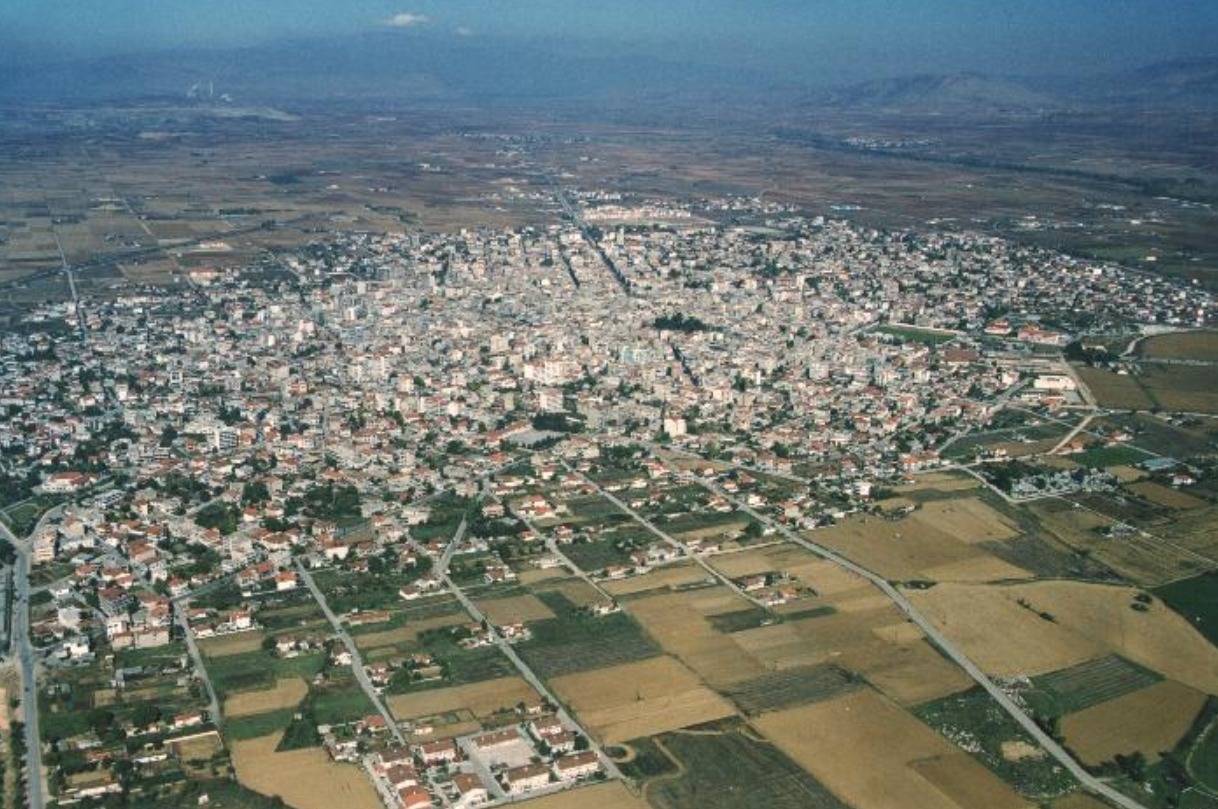
The Greek city of Ptolemais today. Image source: wikimedia.org
What Scientists Found at the Ship Graveyard
While Piotr Jaworski led the underwater excavations, Szymon Lenarczyk headed the land team. On the way to the ancient city on the hill, they discovered a road for wheeled carts. And at the very gates of Ptolemais, a Greek inscription dating to the 3rd century CE was found.
Inside the city, researchers excavated remains of a residential quarter. Among them was the entrance area of a house belonging to a high-ranking government official. But the most intriguing find was a set of mysterious objects discovered outside this house: a mask depicting a human face and several stone containers. Why they were left precisely here remains a mystery that archaeologists are puzzling over.
In addition, conservators are working on-site. They are restoring wall mosaics, paintings, and rare double-disc sundials first discovered by the expedition back in 2010. Such sundials are a great rarity in the ancient world.
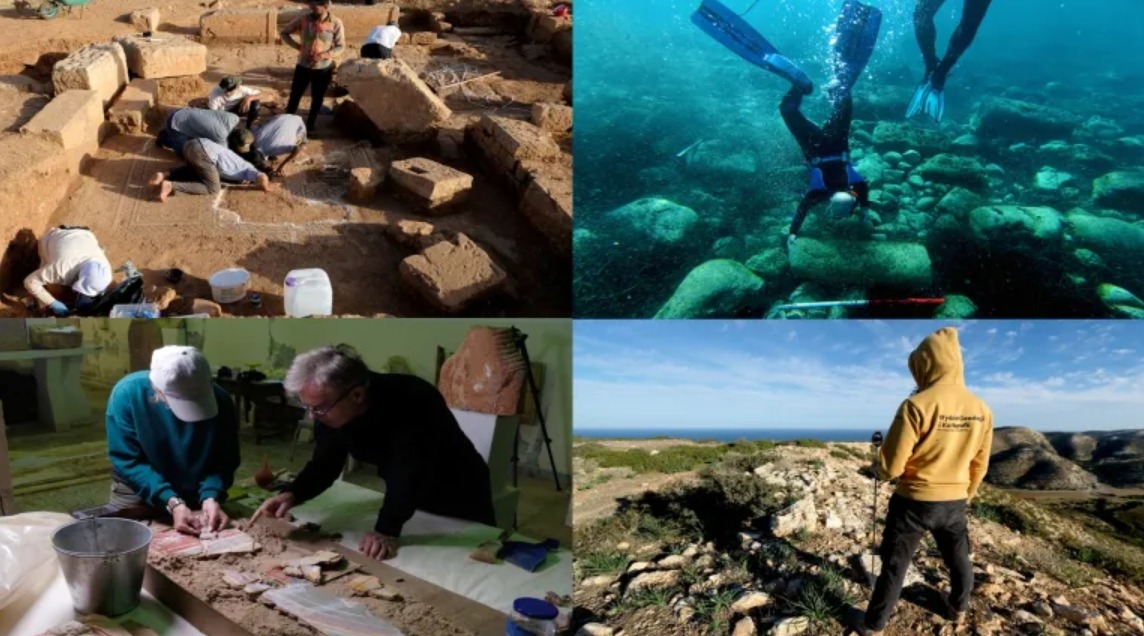
Photos from the excavations in Libya. Image source: interestingengineering.com
What Hindered Excavations in Libya
The Polish archaeological mission began work in Ptolemais back in 2001. Scientists studied the city for ten years until civil war erupted in 2011 and forced them to leave Libya. A return became possible only in 2023 thanks to a new excavation permit signed in Tripoli.
It turns out that during the Poles’ absence, local researchers continued making discoveries: finding new inscriptions and coins. Over the years of work, the University of Warsaw expedition has discovered approximately 3,000 coins in Ptolemais. Their analysis helps determine the city’s periods of prosperity and decline, as well as its main trade routes.
In 2026, Polish researchers are celebrating the 25th anniversary of archaeological work in Libya. And judging by the scale of recent discoveries, the most interesting part is still ahead: a significant portion of the ancient city remains unexplored both on land and underwater.