For a long time, comparisons between iOS and Android in terms of browser performance didn’t favor the latter. But in March 2026, Google officially announced: flagship Android smartphones now show the best results among all mobile platforms in key web performance tests. If you thought Apple was better than Android in terms of web browsing speed — it’s time to reconsider that view. The balance of power is changing.
Android finally brought the heat
How Browser Speed Affects Your Smartphone
Many people underestimate this aspect, thinking the browser is just another app. In reality, it’s quite different. Over 90% of Android apps use WebView — a built-in engine for rendering web content. This means web speed directly determines how fast your smartphone operates across a wide range of scenarios:
- news feeds and social networks with web inserts;
- online stores and banking apps;
- built-in maps and delivery services;
- any apps with WebView-based advertising;
That’s precisely why Google set out to optimize not just Chrome itself, but the entire stack: from hardware and the OS kernel to CPU scheduler policies. The result was impressive — and now Android is faster than iOS in both key web performance benchmarks.
How Browser Speed Is Measured on Android
Google used two assessment tools. The first is Speedometer, the industry standard for measuring web application responsiveness. It simulates real user actions: adding tasks, working with text editors, rendering charts based on popular frameworks — React, Angular, jQuery. The higher the score, the smoother a site feels when tapping, scrolling, and entering text.
The second tool is LoadLine, developed by Google in collaboration with chip and smartphone manufacturers. It measures loading speed of real websites: stores, search engines, news portals. The results were convincing: an Android flagship shows LoadLine results 47% higher than competitors on other platforms. This is no longer a lab difference on graphs — it directly correlates with page loading speed for real users.
How Much Faster Android Has Become
The performance gains resulted from Google’s collaborative work with processor and smartphone manufacturers. Everything was optimized: hardware behavior under load, OS kernel policies, and the Android browser engine. As a result, some flagships improved their Speedometer and LoadLine scores by 20-60% compared to their predecessors.
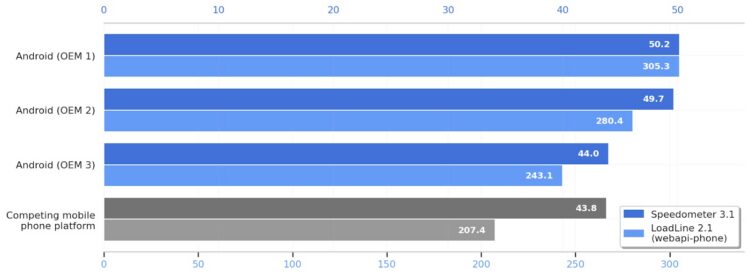
Browser performance has significantly improved. Source: Chrome
In real-world conditions, this translates to specific numbers:
- pages now load 4-6% faster;
- interaction delay with websites decreased by 6-9%;
- on tablets and foldable smartphones the effect is most noticeable — that’s where web scenarios are used most intensively;
These may sound like modest numbers, but for daily use the difference is noticeable — especially if you spend a lot of time in the browser or apps with web content.
Android vs iPhone: Which Is Better
Browser speed is far from the only criterion when choosing a smartphone, but it’s an indicative one. For a long time, it was believed that newer Android was better than iPhone only in terms of price-to-specs ratio, while Apple was always ahead in performance. Now the situation has changed in at least one important segment. Android is already outpacing iPhone in fraud protection — and now a web speed advantage has been added to that.
The choice between Android or iOS still remains a matter of personal preference and ecosystem. However, there are increasingly more arguments in favor of Android, and browser speed is one of them.
Why Not Every Android Is Better Than iPhone
It’s important to understand: we’re talking about flagship Android devices, not the entire segment as a whole. Android phones are better than iPhone in test results specifically in the top-tier segment — where manufacturers invest in hardware and software stack optimization jointly with Google. Budget and mid-range models don’t fall under these statistics.
Additionally, it’s worth remembering that Android speed in the browser was measured in Chrome 146 on current flagships. If you’re using a different browser or a device that’s two or three years old — the results will be different. Nevertheless, the trend is clear: Google has been consistently closing the gap with Apple where it previously lagged behind, and in 2026, it has come out ahead for the first time in one of the key user scenarios.