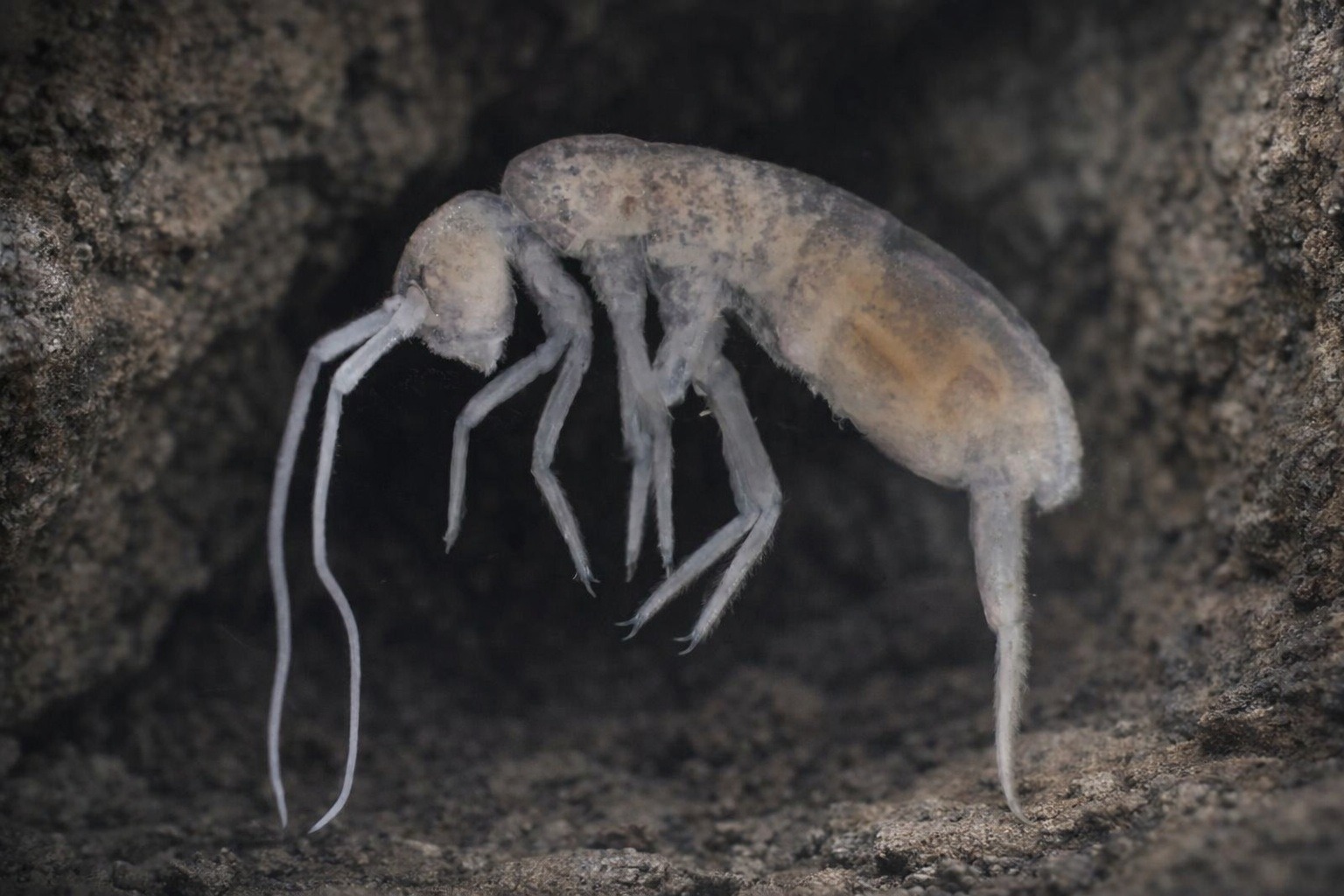
This tiny creature is capable of living in complete darkness
When we think about extreme living conditions, deep oceans or lifeless deserts come to mind. But what about pitch-black darkness, tremendous pressure, and a complete absence of sunlight nearly two kilometers underground? It turns out that right there, in the depths of one of the deepest caves on the planet, scientists discovered a tiny creature that feels perfectly at home. Meet Plutomurus ortobalaganensis — the record holder among terrestrial animals for depth of habitat.
Who Lives Deep Underground
Plutomurus ortobalaganensis is a springtail, or collembolan, a tiny arthropod only about a millimeter in size. Springtails are not insects in the strict sense, although they look very similar. They are a separate class, among the most ancient terrestrial creatures on the planet, having appeared hundreds of millions of years ago.
This creature was discovered in Krubera-Voronya Cave, located in the Arabika mountain massif in Abkhazia. This cave held the title of the deepest in the world for a long time, with an explored depth exceeding 2,196 meters. For comparison, that’s roughly five Eiffel Towers stacked on top of each other — only going into the Earth.
Specimens of Plutomurus ortobalaganensis were collected at a depth of 1,980 meters — an absolute record for any terrestrial animal. Before this discovery, scientists didn’t even suspect that complex multicellular organisms could survive at such depths. The finding was described in the journal Terrestrial Arthropod Reviews and instantly attracted the attention of biologists worldwide.
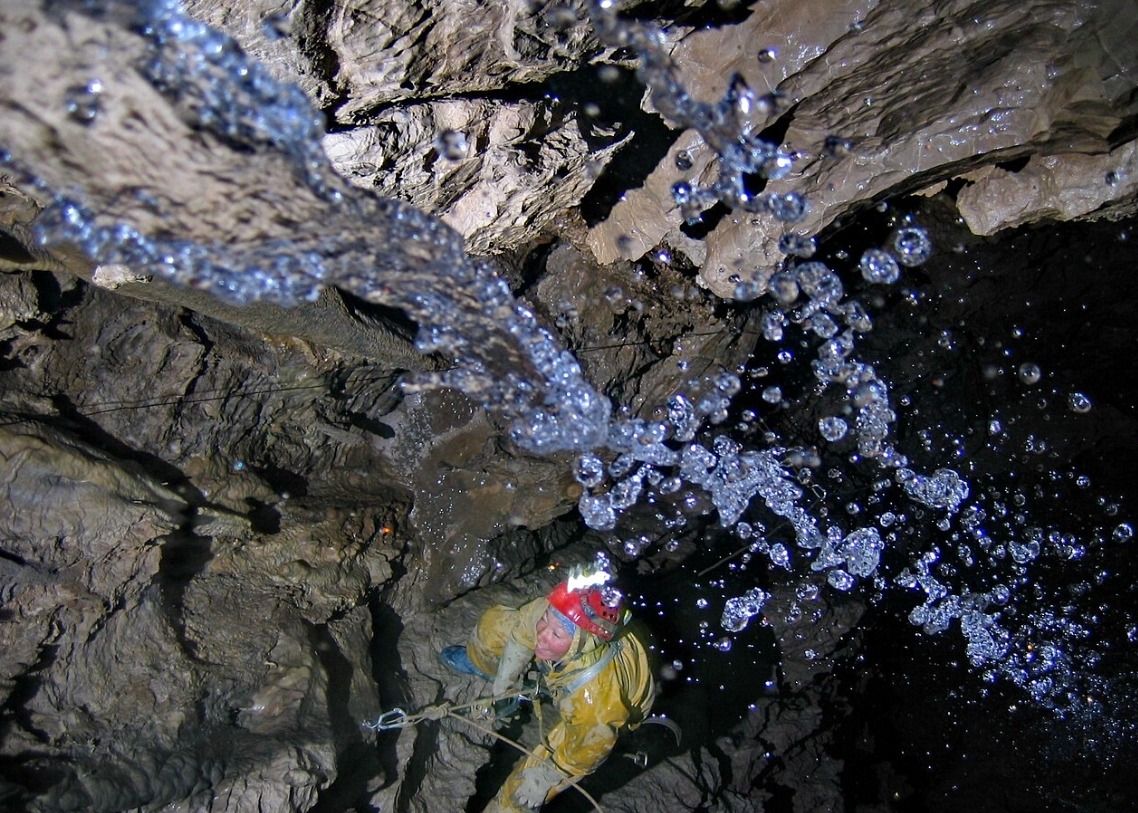
Krubera-Voronya Cave. The Apron Well. Image source: wikipedia.org
How an Underground Animal Lives Without Food
Life at a depth of nearly two kilometers underground is quite the challenge. There is no sunlight here, which means no photosynthesis and no familiar food chains. The temperature is consistently low, and humidity is close to 100%. It would seem there’s nothing to sustain life here.
The thing is, springtails feed on microscopic fungi and bacteria that form the thinnest films on cave walls and rocks. These microorganisms, in turn, obtain energy not from the sun but from chemical reactions in the rock. This type of ecosystem is called chemolithoautotrophic — in simpler terms, life here is built on rock chemistry, not light.
Plutomurus ortobalaganensis is completely devoid of pigmentation — it is white, almost transparent. It has no eyes, because in eternal darkness they are simply unnecessary. Instead, it has developed sensitive antennae that help it navigate its surroundings. This is a classic example of how evolution “switches off” everything unnecessary and “switches on” what truly matters.
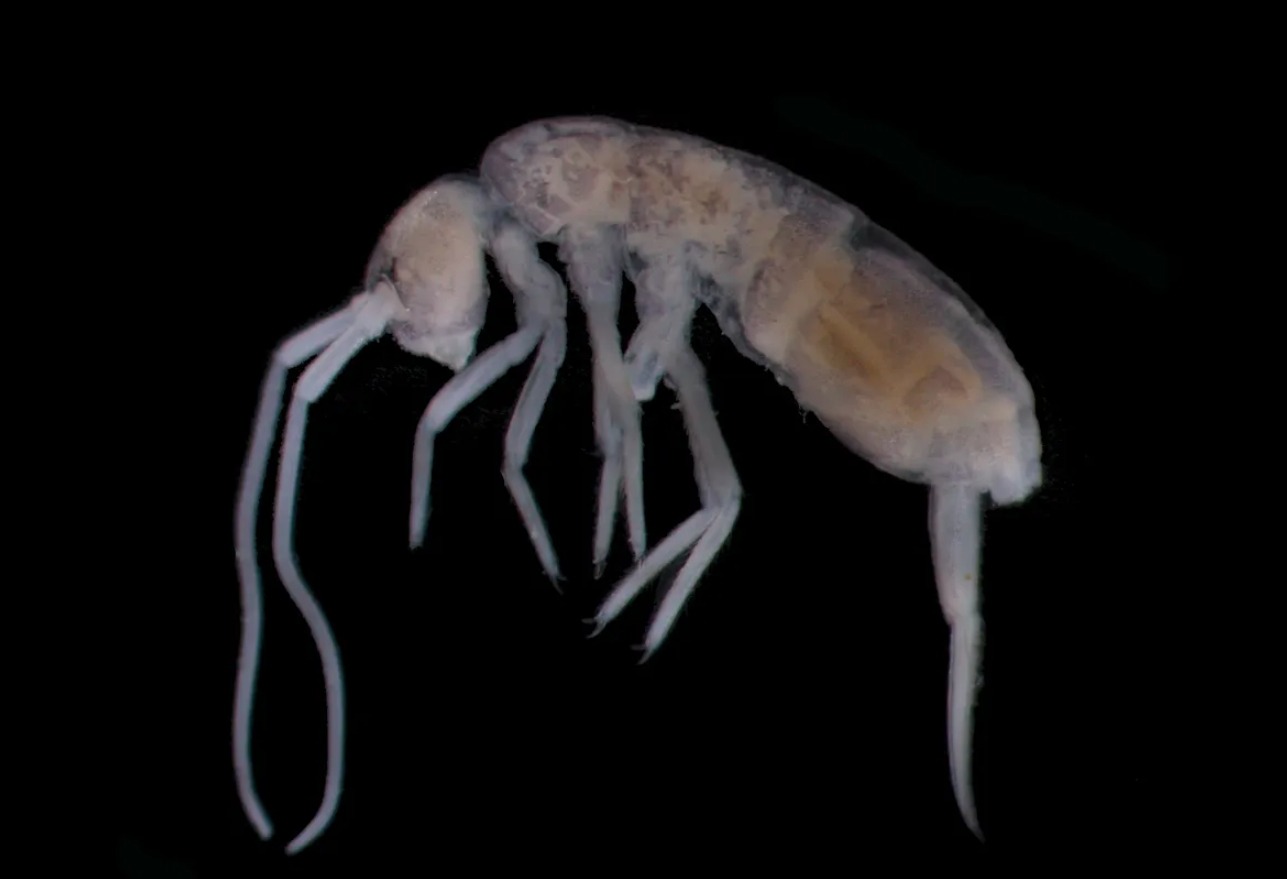
Springtail Plutomurus ortobalaganensis. Image source: iflscience.com
Why Krubera-Voronya Cave Is Suitable for Life
Krubera Cave is not just a hole in the ground. It is an incredibly complex system of vertical shafts, horizontal galleries, and narrow passages that formed over millions of years in limestone rock. Water seeping from the surface brings a minimal amount of organic matter here, but for microscopic inhabitants, that is enough.
In fact, Plutomurus ortobalaganensis is not the only species found at record depths in this cave. Along with it, three more species of springtails new to science were discovered, each adapted to its own specific depth range. This means that a whole distributed community exists underground, one that formed long before humans even knew about this cave.
Interestingly, conditions in the depths of Krubera-Voronya are remarkably stable: the temperature stays around 7 degrees Celsius year-round, and humidity barely changes. For springtails, this is an ideal environment — no predators, no droughts, no seasonal fluctuations. However, food is very scarce, so the metabolism of these creatures is likely slowed to a minimum.
What the Discovery of Underground Animals Means for Science
The discovery of Plutomurus ortobalaganensis forced scientists to reconsider the boundaries of habitability on our planet. If life can thrive in such extreme conditions on Earth, then perhaps analogous ecosystems exist on other celestial bodies. For example, under the icy crust of Europa, Jupiter’s moon, or in subsurface cavities on Mars.
But there is a nuance. So far, scientists cannot precisely determine how long ago springtails colonized such depths. Perhaps their ancestors became trapped millions of years ago when cave passages were still closer to the surface, and then gradually adapted as the system deepened. Or perhaps they actively migrated downward, following microbial “pastures.” The answer to this question could overturn our understanding of Earth’s subterranean biosphere.
Furthermore, studying extremophiles — organisms living in extreme conditions — helps biotechnologists. The enzymes of such creatures often prove useful in medicine and industry. Who knows, maybe the tiny, eyeless springtail from an Abkhazian cave will one day give us a new antibiotic or a method for water purification.