Just yesterday, businesses were calmly buying ad integrations from bloggers, and channel creators were earning from native placements — and nobody was particularly worried about whether Telegram would be permanently blocked in Russia. But on March 5, 2026, everything changed: Russia’s FAS (Federal Antimonopoly Service) officially declared that advertising on Telegram, YouTube, WhatsApp*, Instagram*, and Facebook* is a violation of the law. What’s behind this and what to expect — let’s break it down.

Now everyone will only be “thinking about MAX”
Why FAS Considers Advertising on Telegram Illegal
The essence of FAS’s position boils down to one simple formula:
According to the advertising law, “the distribution of advertising on certain information resources, including those whose access is restricted in accordance with the legislation of the Russian Federation, is not permitted”.
And by March 2026, Roskomnadzor had already taken measures to restrict access to several major platforms: social networks Instagram* and Facebook*, video hosting YouTube, VPN services, and messengers Telegram and WhatsApp*. This is exactly what the antimonopoly service refers to. Since access is restricted — advertising on these resources automatically falls under the ban. Responsibility is borne by both advertisers and those who distribute advertising — meaning bloggers and channel creators.
The trigger for the high-profile announcement was a real case. Roskomnadzor filed a complaint with FAS about an advertising integration of a fitness platform in a Telegram channel run by fashion blogger Maria Loskutova. The case was opened on February 26, and by March 5, FAS extended its position to all the listed platforms. Thus, platforms that were recently the main advertising channels for Russian business now carry the risk of fines for placing ads on them.
Which Law Prohibits Advertising on Blocked Platforms
The ban is based on Part 10.7 of Article 5 of the Federal Law “On Advertising”. This amendment came into force on September 1, 2025 and was introduced by Federal Law No. 72-FZ dated April 7, 2025. Initially, the regulation was primarily aimed against advertising on Instagram* and Facebook* — platforms owned by Meta*.
But there’s a nuance. The wording of the law is broader than it might seem. It prohibits advertising not only on resources of extremist organizations but also on any platforms whose access is restricted. This is exactly what allowed FAS to broaden its interpretation — and extend the ban to Telegram, YouTube, and WhatsApp*, even though none of these services have been designated as extremist or undesirable.

The new law came almost out of nowhere
However, Telegram is considered an unsafe means of communication in our country. It is said that your private messages can be read by someone else.
Penalties for violations include fines: for an advertiser that is a legal entity — up to 500 thousand rubles, for an advertising distributor who is a sole proprietor — up to 20 thousand rubles. The statute of limitations is 1 year. This means a fine can be issued even for placements made before the law was adopted — several months ago.
How Roskomnadzor Restricted Access to Telegram, YouTube, and WhatsApp
To understand why FAS’s position turned out to be so broad, one needs to trace the timeline of restrictions. Instagram* and Facebook* were blocked in Russia back in 2022. Their situation is more or less clear — Meta* was designated as an extremist organization. With other platforms, the situation developed gradually. In August 2025, Roskomnadzor blocked audio and video calls on Telegram and WhatsApp.
However, waves of traffic throttling began as early as 2024, and at first, nobody even understood what the slowdown of WhatsApp in Russia would lead to. In November 2025, Roskomnadzor officially confirmed the blocking of WhatsApp*. And on February 10, 2026, the agency announced restrictions on Telegram’s operation due to “non-compliance with Russian legislation.”
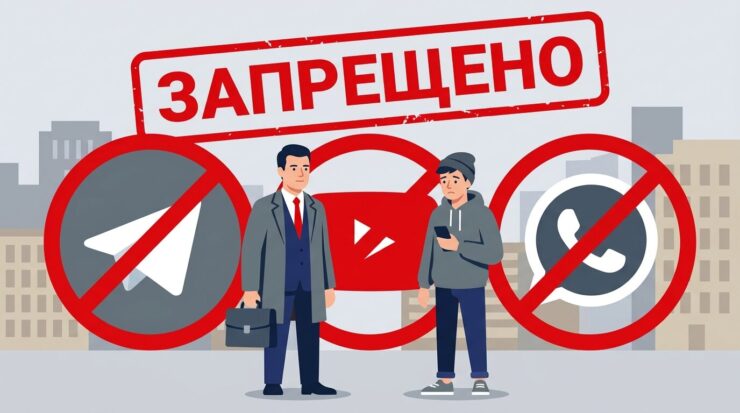
The law exists, and one has to reckon with it, although many still don’t understand how it will work
As for YouTube — it was also being throttled since mid-July 2024, and in February 2026, the video hosting domain simply disappeared from the National Domain Name System (NSDI). In practice, this meant a complete block. By February 11, at least 13 popular resources had been removed from the NSDI. Essentially, Roskomnadzor simply removed these websites and platforms from the Russian internet.
Formally, Telegram and YouTube are not included in either Roskomnadzor’s registry of blocked resources or the Ministry of Justice’s list of undesirable organizations. Moreover, both services are still listed in the social network registry of the same Roskomnadzor. But FAS interprets the law broadly: since access is de facto restricted — advertising is prohibited.
What Will Happen to the Advertising Market Due to the Ban
The scale of consequences is hard to overestimate. By early 2026, Telegram had become one of three key advertising platforms in Russia — alongside Yandex and VKontakte. According to various estimates, Telegram accounted for up to 50% of the segment, and together with YouTube, these platforms represented up to 70% of the volume.
The numbers are impressive. In 2025, Russian companies increased their Telegram advertising budgets by 297%. Forecasts predicted market growth to 35 billion rubles in 2026. The total digital advertising market in Russia at the end of 2025 was estimated at 50–60 billion rubles. The country’s entire advertising flow grew to 1.9 trillion rubles.

Banned platforms were the main sources of income for bloggers
The market reaction was instant. Major advertising groups, including Media Direction Group, began pausing placements on Telegram. However, a massive halt has not been recorded yet — participants are waiting for final clarifications from regulators.
The thing is, the legal situation is ambiguous. Lawyers point out: it’s unclear even from what moment advertising on Telegram is considered prohibited. If from August 2025, when calls were restricted, then logically only voice advertising should be considered banned. And if Telegram is not officially in the blocked resources registry — on what basis does the ban even apply?
What Businesses and Bloggers Should Do Right Now
FAS has already opened the first cases — and not just for Telegram. Blogger Alexandra Posnova reported that a case was opened against her for advertising on YouTube. Roskomnadzor itself is filing complaints with the antimonopoly service, meaning the mechanism for identifying violations is already in motion.
What does FAS recommend? The agency advises business owners to check where exactly their advertising is currently placed. If the platforms have fallen under restrictions — it’s better to remove advertising materials from there to avoid legal problems.

The advertising business no longer faces a choice of which platform to go to — now everything is clear, there’s only one path