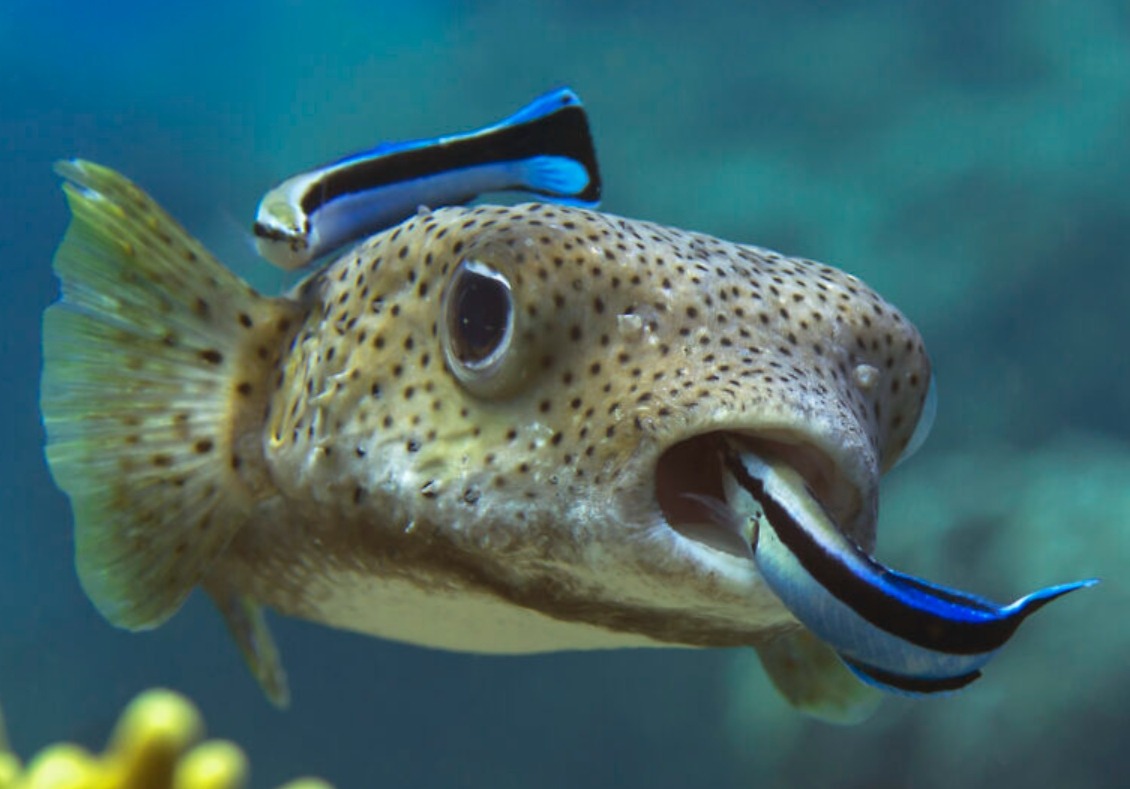
In the wild, cleaner wrasses are known for their cleanliness. Image source: sciencealert.com
When we think of smart animals, we usually recall dolphins, chimpanzees, or at least crows. Fish rarely make this list — the stereotype of “three-second memory” is just too strong. But a tiny cleaner wrasse the length of an index finger didn’t just recognize itself in a mirror — it used the reflection as a tool. And this changes our understanding of fish intelligence.
What Is the Mirror Test
The mirror test, also known as the mark test, was invented in 1970 by American psychologist Gordon Gallup Jr. The concept is simple: a colored mark is placed on an animal’s body that can only be seen in a reflection. If the animal notices the spot and tries to examine or remove it from its own body rather than from the mirror, this is considered a sign of self-recognition — the ability to understand that the reflection in the mirror is itself.
For a long time, only “elite” species successfully passed this exam: chimpanzees, orangutans, Asian elephants, dolphins, and magpies. Each new candidate on this list became a scientific sensation. It was believed that self-recognition required a large and complex brain with a developed cortex — meaning fish had no chance of making the cut.
But in 2018, everything changed. A group of Japanese scientists reported that the mirror test had been passed by the cleaner wrasse (Labroides dimidiatus) — a small tropical fish that inhabits coral reefs. The scientific community was, to put it mildly, bewildered.
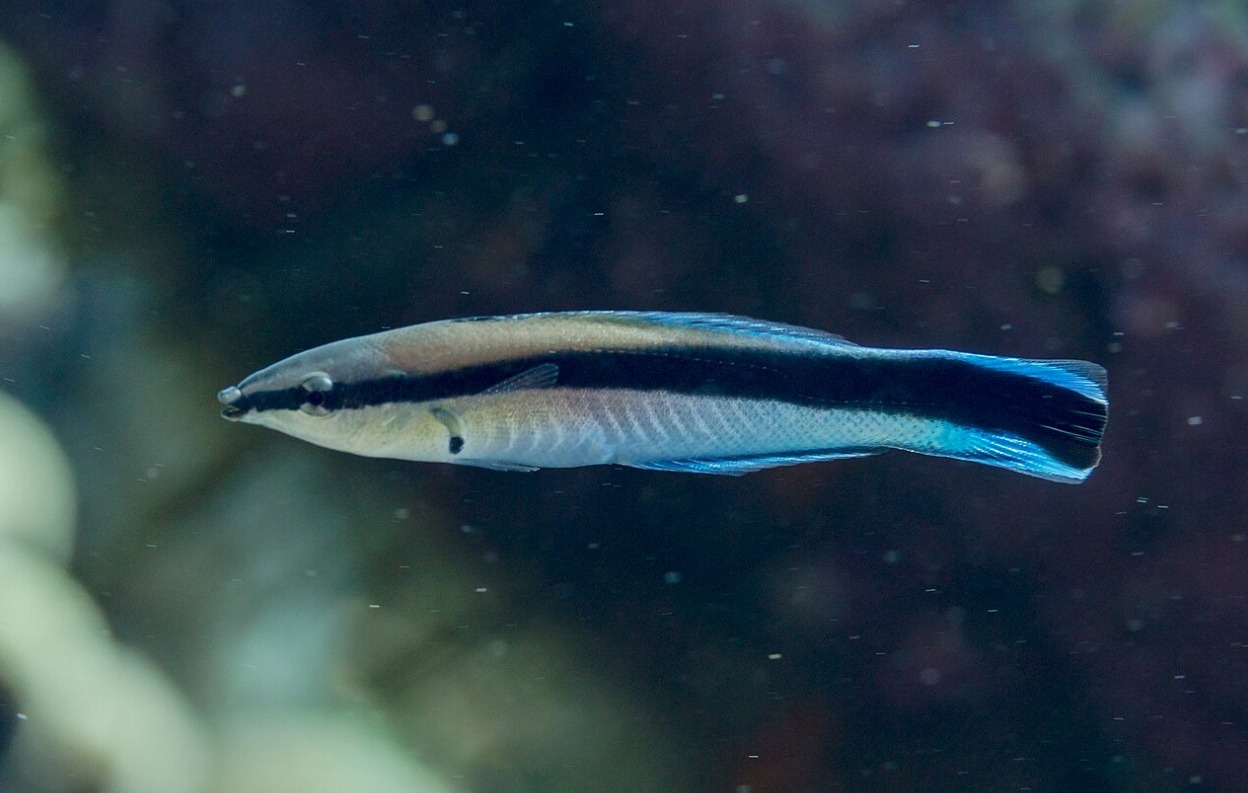
Cleaner wrasse fish. Image source: wikipedia.org
Why the Cleaner Wrasse Turned Out to Be Smart
At first glance, it seems strange: why this particular fish, and not, say, an octopus or a parrot? The thing is, the cleaner wrasse performs very delicate social work in the wild. It operates “cleaning stations” on the reef, where larger fish come to get rid of parasites and dead tissue. The wrasse must flawlessly distinguish a parasite from the living skin of its client — one mistake, and the client swims away forever.
This lifestyle requires advanced cognitive abilities: the fish needs to remember “clients,” assess their mood, and build long-term relationships. Simply put, a fish no larger than 10 centimeters behaves like a beauty salon owner with a loyal clientele.
It turns out that this social complexity served as an evolutionary springboard for the development of self-awareness. If you interact with dozens of other creatures every day and need to remember who you are versus who they are, the ability to recognize yourself in a reflection stops seeming so incredible.
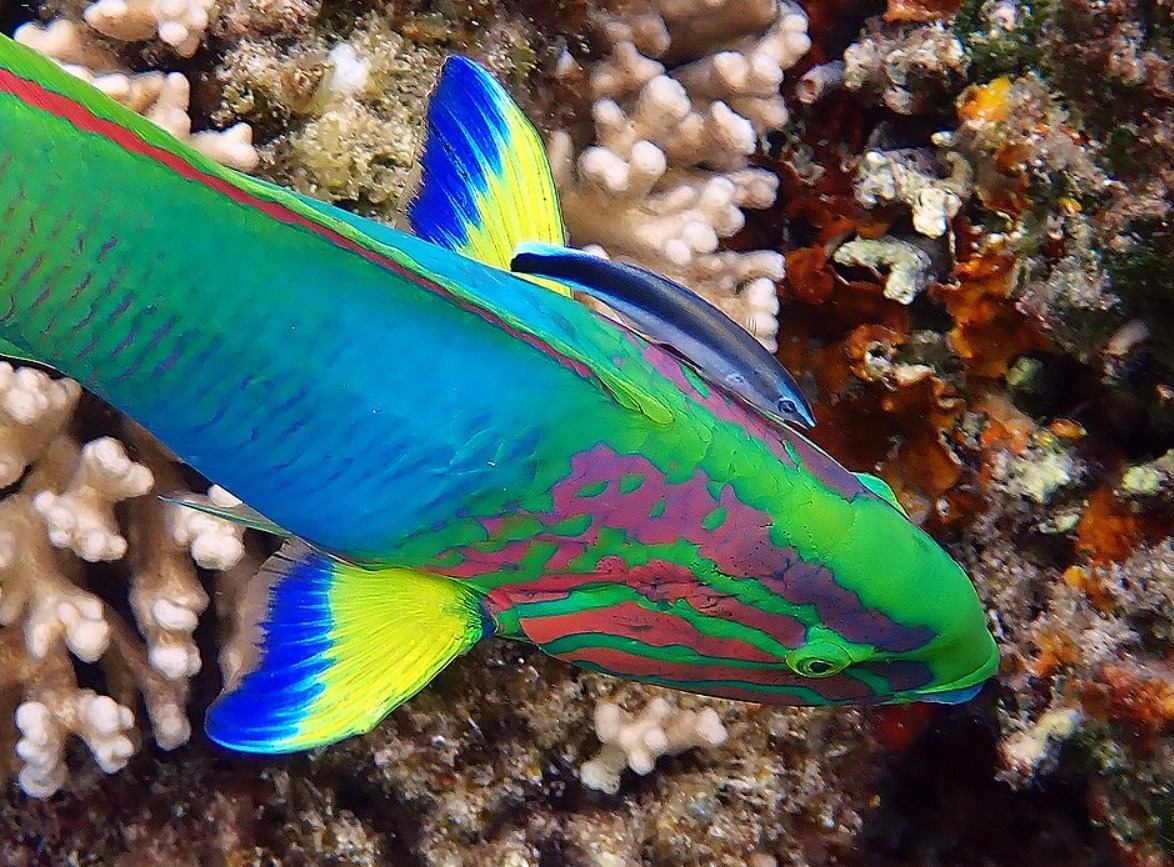
Cleaner wrasse with a larger fish. Image source: wikimedia.org
How the Fish Passed the Mirror Test
New experiments by the Japanese team went further. The scientists didn’t just repeat the classic mark test — they made the task more complex. The fish were offered a piece of food placed so that it could only be seen through the mirror. And this is where things get really interesting.
The wrasses didn’t just notice the food in the reflection — they used the mirror as a tool to find the actual location of the food. The fish looked in the mirror, then turned around and swam to where the food actually was. This behavior demonstrates not just self-recognition, but an understanding of how reflection works — a skill previously documented only in great apes.
For comparison: many dogs, when seeing a mirror, either bark at the "stranger" or lose interest. Meanwhile, a tiny fish with a brain the size of a pea figured out the optical properties of a reflective surface. This forces us to reconsider the very idea that intelligence directly depends on brain size.
Figuring out the mirror turned out to be well within the fish’s abilities. Scientists, however, still debate whether this can be called “consciousness.”
What Scientists Learned About Animal Consciousness
The results of experiments with the cleaner wrasse called into question several fundamental assumptions. First, self-recognition apparently doesn’t require a neocortex — that very “thinking” part of the brain found only in mammals. Fish have no neocortex at all, yet they manage the task.
Second, the mirror test may not be measuring exactly what we thought. If a fish can pass it, then either self-awareness is far more widespread in the animal kingdom than previously believed, or the test captures not “awareness of oneself as an individual” but a simpler yet still impressive cognitive skill — the ability to model space and one’s place within it.
Some critics, however, aren’t rushing to label the wrasse a genius. They suggest the fish may have been reacting to the mark as if it were a parasite — after all, its job is precisely to find and remove foreign spots. But the use of the mirror as a tool for finding food weakens this argument considerably. You don’t look for parasites in food.
Why This Discovery Is So Important
You might wonder: why should an ordinary person care whether a fish recognizes itself in a mirror? But this research actually touches on a question that concerns philosophers, neurobiologists, and even artificial intelligence developers: what is consciousness and how did it emerge?
If self-recognition is possible without a complex cerebral cortex, it means evolution “invented” elements of consciousness multiple times independently in different groups of animals. This is called convergent evolution of cognitive abilities — and it hints that the beginnings of self-awareness may be far more ancient than we are accustomed to thinking.
For AI researchers, this is also an important signal: the emergence of “self-understanding” doesn’t necessarily require enormous computational power. Perhaps the key lies in the right architecture, not in the number of neurons. The wrasse’s brain contains only about 3–4 million neurons — for comparison, humans have around 86 billion. And yet this little reef fish has forced scientists around the world to reconsider the boundaries of the mind.