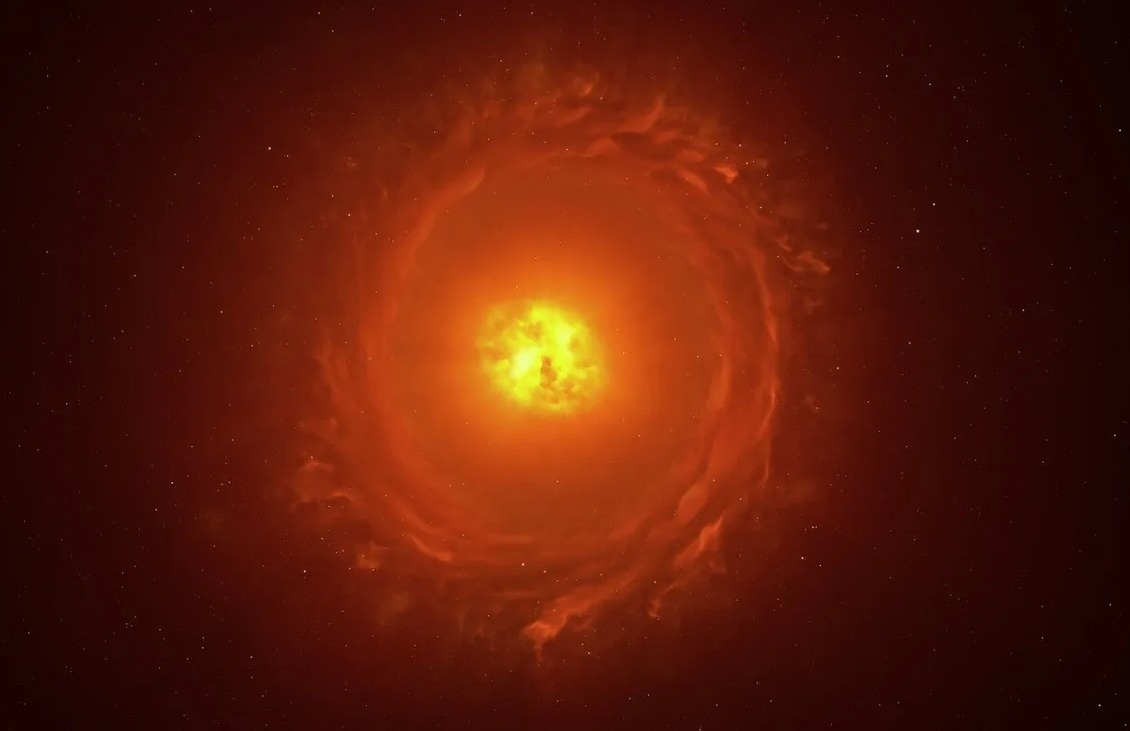
Artistic depiction of WOH G64, one of the largest known stars. Image source: iflscience.com
Imagine a star so enormous that if placed where the Sun is, it would engulf Jupiter’s orbit. Now imagine that this star suddenly began dimming before astronomers’ eyes — within a matter of months. This is exactly what is happening right now with the hypergiant WOH G64, and scientists are seriously discussing whether we might be on the verge of observing a supernova in real time.
What Is WOH G64 and Why Is This Star Special
WOH G64 is a red hypergiant located in the Large Magellanic Cloud, a dwarf satellite galaxy of the Milky Way, at a distance of about 160,000 light-years from Earth. The star is so colossal that its radius exceeds the Sun’s by approximately 1,500–2,000 times. For comparison, if WOH G64 were placed at the center of our Solar System, its surface would extend far beyond Jupiter’s orbit.
It is one of the largest stars known to science. But size isn’t the only thing that makes it interesting. WOH G64 is surrounded by a dense torus of dust and gas — a kind of “donut” that the star itself ejected. Red hypergiants in the late stages of their lives actively lose mass, literally shedding their outer layers into the surrounding space. Simply put, the star is slowly dying, and doing so quite spectacularly.
Until recently, WOH G64 behaved predictably. Astronomers had been observing it for decades, recording its characteristic infrared glow and stable brightness. But in 2024, everything changed.
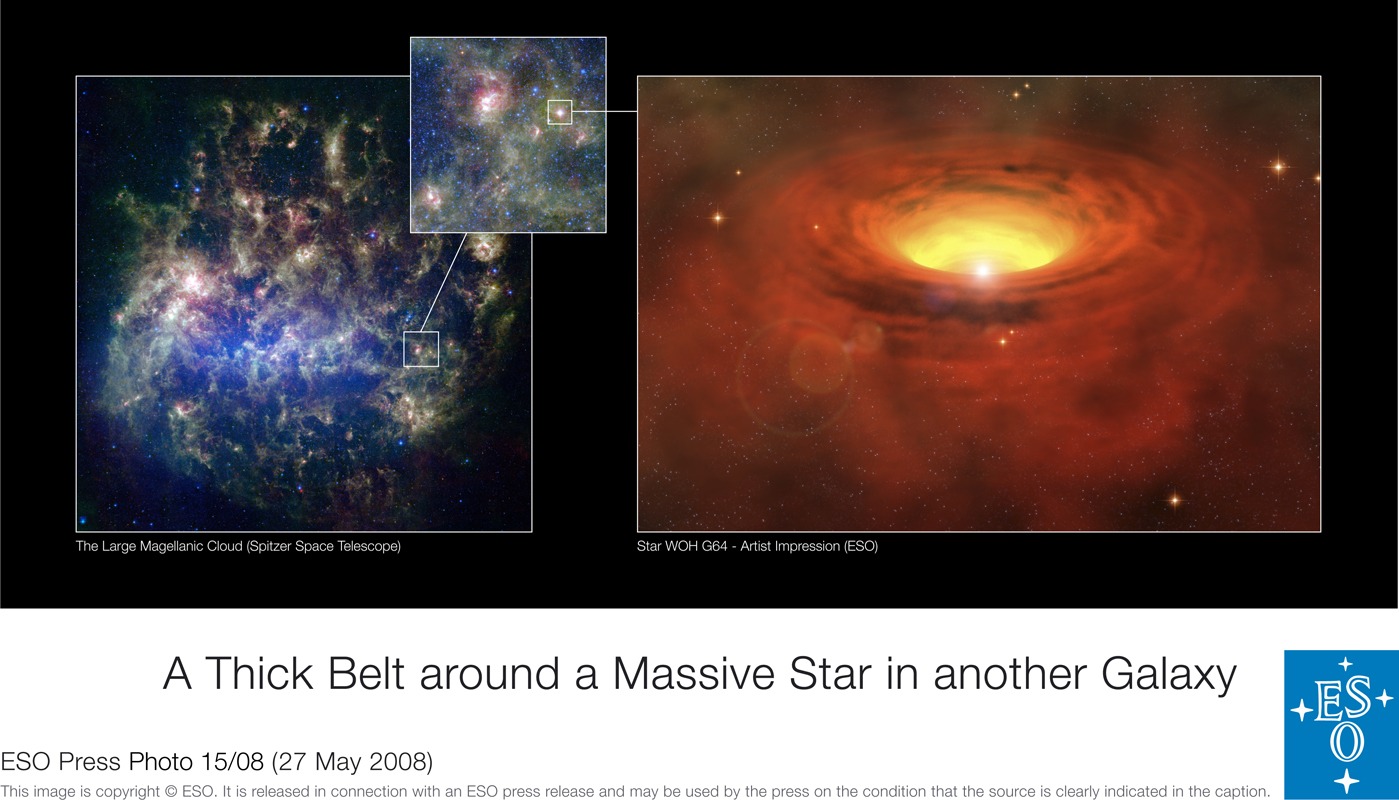
Star WOH G64. Image source: wikipedia.org
How the Star Changed Color and What It Means
In late 2024, a group of astronomers noticed something strange: the spectral class of WOH G64 shifted from red toward blue. This might seem insignificant, but for stellar physics it is a colossal signal. Red hypergiants are called red precisely because they have a relatively low surface temperature — around 3,000–3,500 degrees Kelvin. If a star begins turning blue, it means its surface is heating up. And this can happen for several reasons.
The first scenario — the star shed a significant portion of its outer shells, exposing hotter layers beneath. The second — internal processes related to thermonuclear burning of heavy elements have dramatically accelerated. Both scenarios point to one thing: WOH G64 may be approaching the final stage of its evolution.
The thing is, massive stars in the final stages of their lives begin “burning” increasingly heavier elements in their cores — from helium to carbon, then to oxygen, and onward up to iron. Each successive stage lasts shorter than the last. If hydrogen burning takes millions of years, silicon burning — the last fuel before collapse — can take mere days. After that, the core collapses, and a supernova explosion occurs.
Could WOH G64 Explode in the Near Future
This is where things get most interesting — and most uncertain. In reality, “near future” in astronomy is a flexible concept. When scientists say a star will “soon” explode, they might mean tomorrow or ten thousand years from now. But in the case of WOH G64, there are reasons to believe we’re talking about a comparatively short timeframe — from several years to several decades.
However, there are skeptics. Some astrophysicists point out that the color change could be explained not by internal processes within the star, but by changes in the surrounding dust. If the dense dust shell partially dispersed or shifted, we might simply be seeing the star more clearly, without the dust filter. In that case, the star hasn’t become hotter — it has simply become more visible. But even this scenario is significant: it tells us that serious dynamic changes are occurring around WOH G64.
Another nuance — Betelgeuse, the famous red supergiant star in the constellation Orion, already caused a similar stir in 2019–2020 when it dramatically dimmed. Many expected a supernova at the time, but it turned out the star had simply ejected a dust cloud that temporarily obscured it. WOH G64 could deliver a similar surprise. Or it might not.
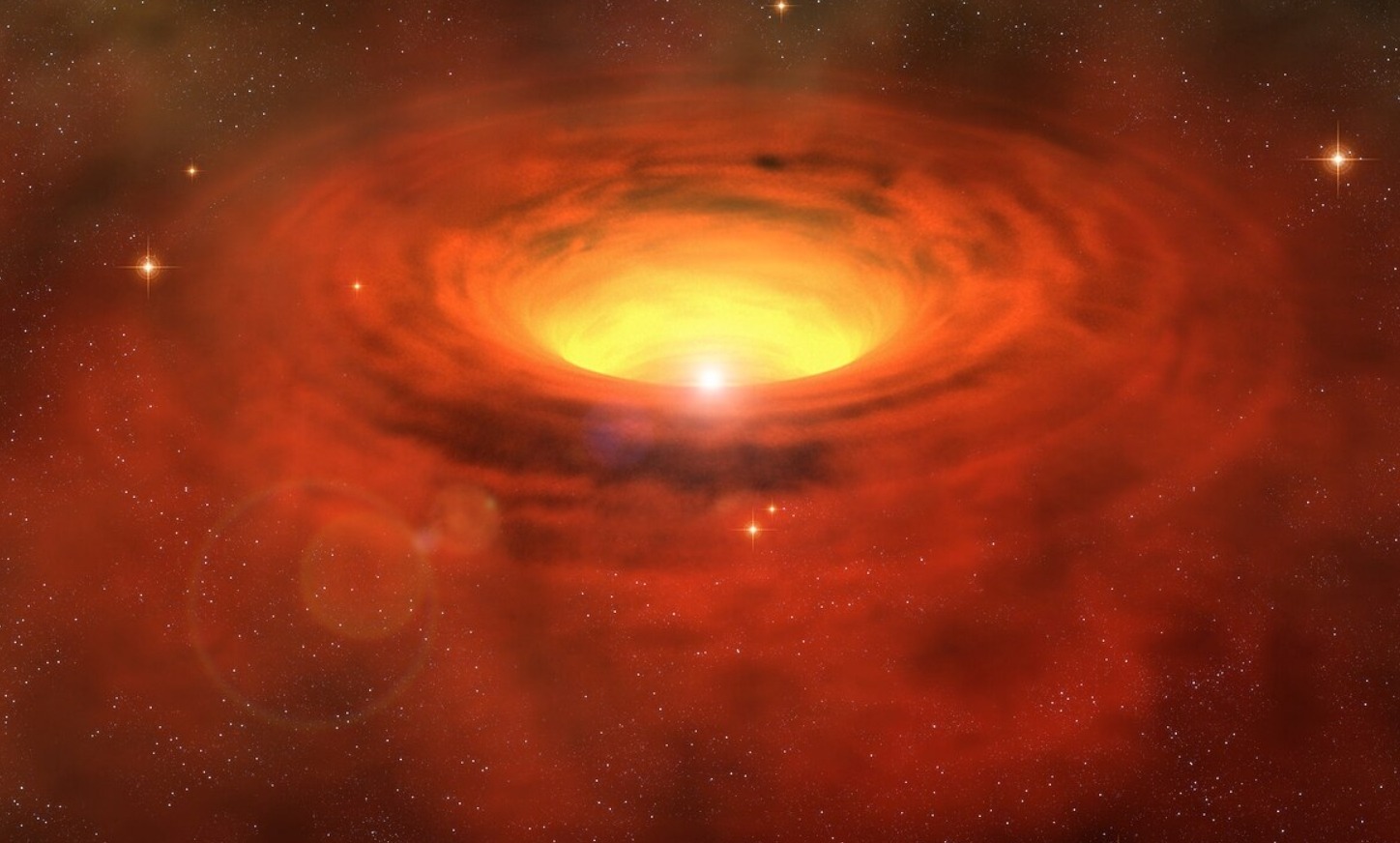
Scientists still don’t fully understand what is happening with WOH G64. Image source: wikimedia.org
What Will Happen If WOH G64 Goes Supernova
If (or when) WOH G64 explodes, it will become one of the brightest astronomical events observable from Earth. Given the distance of 160,000 light-years, the explosion poses no threat to our planet — neither radiation nor a shockwave would reach us. But the flash could become visible to the naked eye even during daytime, as was the case with historical supernovae of past centuries.
For astrophysicists, this would be a true gift. The last supernova observed “live” with modern instruments occurred in 1987 — the famous SN 1987A, also in the Large Magellanic Cloud. It yielded a colossal amount of information about the physics of collapsing stars, neutrino streams, and the formation of neutron stars. A new supernova in the same region, but with far more advanced telescopes, including the James Webb Space Telescope, could revolutionize our understanding of stellar death.
As of today, astronomers have intensified monitoring of WOH G64, using both ground-based observatories and space telescopes. Every new spectrum, every change in brightness is carefully analyzed. The star could quiet down and return to its previous state, or it could continue its path toward the finale.
If WOH G64 goes off, we will have a chance to observe a supernova with the best telescopes in human history. This happens once every few centuries.
One thing is certain: WOH G64 reminds us that the Universe is not a frozen picture from a textbook, but a living, changing system where even the largest stars are mortal. And sometimes they give advance warning — you just need to look at the right point in the sky at the right time.