
Organic artifacts are extremely rarely preserved in the archaeological record — making each such find all the more valuable
A fragment of processed deer hide, sewn together from several pieces using twisted cord and secured with a knot, lay in a cave in present-day Oregon for over 12,000 years. Now scientists have for the first time examined this and other finds in detail using modern dating methods, and the results are impressive. Before us is the earliest known direct evidence that ancient people didn’t simply throw hides over their shoulders but cut, stitched, and possibly even painted their clothing.
Clothing of Ancient People
It would seem that clothing is one of the most important inventions in human history. Without it, our species simply wouldn’t have survived beyond the tropics. But the paradox is that we know very little about clothing from the distant past. The reason is simple: fabrics, hides, plant fibers — all of these are organic materials that decompose within a few centuries or even faster.
Archaeologists are usually left with only indirect evidence: bone needles, stone scrapers for processing hides, traces of dyes. From these tools, one can guess that people sewed clothing, but exactly what it looked like, what it was made of, and how complex it was remained a mystery. As paleoanthropologist Costantino Buzi notes, the development of sewn clothing is an entire part of cultural evolution that we cannot fully grasp, and it is often overlooked in the study of human evolution.
What Was Found in Cougar Mountain Cave in Oregon
Cougar Mountain Cave in Oregon was excavated back in the 1950s. At the time, archaeologists extracted a collection of ancient objects: 24 items made of plant fibers, 12 wooden tools, and three fragments of processed animal hides. But for decades, these artifacts remained largely unstudied — researchers simply didn’t have the appropriate technologies for accurate dating and detailed analysis.
Everything changed when a team led by Richard Rosencrance from the University of Nevada took on the task. Using modern methods, the scientists re-examined and dated the finds.
We found a relatively small number of objects dating to the late Pleistocene. But among them we found astonishing technological diversity, as well as the use of raw materials that points to a truly complex and detailed knowledge system, — said Rosencrance.
What the Oldest Clothing Looked Like
The main find was an artifact cataloged as CMC21-1 — a small fragment of processed elk hide. Radiocarbon dating showed its age: approximately 12,600 years, making it the oldest known direct evidence of sewn clothing.
This piece of hide consists of several cut pieces joined together with thread. The cord was twisted in a specific way — a so-called Z-twist (where fibers are twisted clockwise). To prevent the thread from slipping out of the seam, it was secured with a knot. Before us is not simply a hide thrown over the shoulders but a product of deliberate construction: cutting, fitting of pieces, sewing, and fastening.
According to Rosencrance, this fragment was probably covered with some kind of dye — for example, ochre. No physical traces of coloring survived on the artifact, but as the researcher explains, this was often a way in which people in the past expressed their identity. In other words, clothing even back then could have been not only functional but also decorative — a way to show group belonging or status.
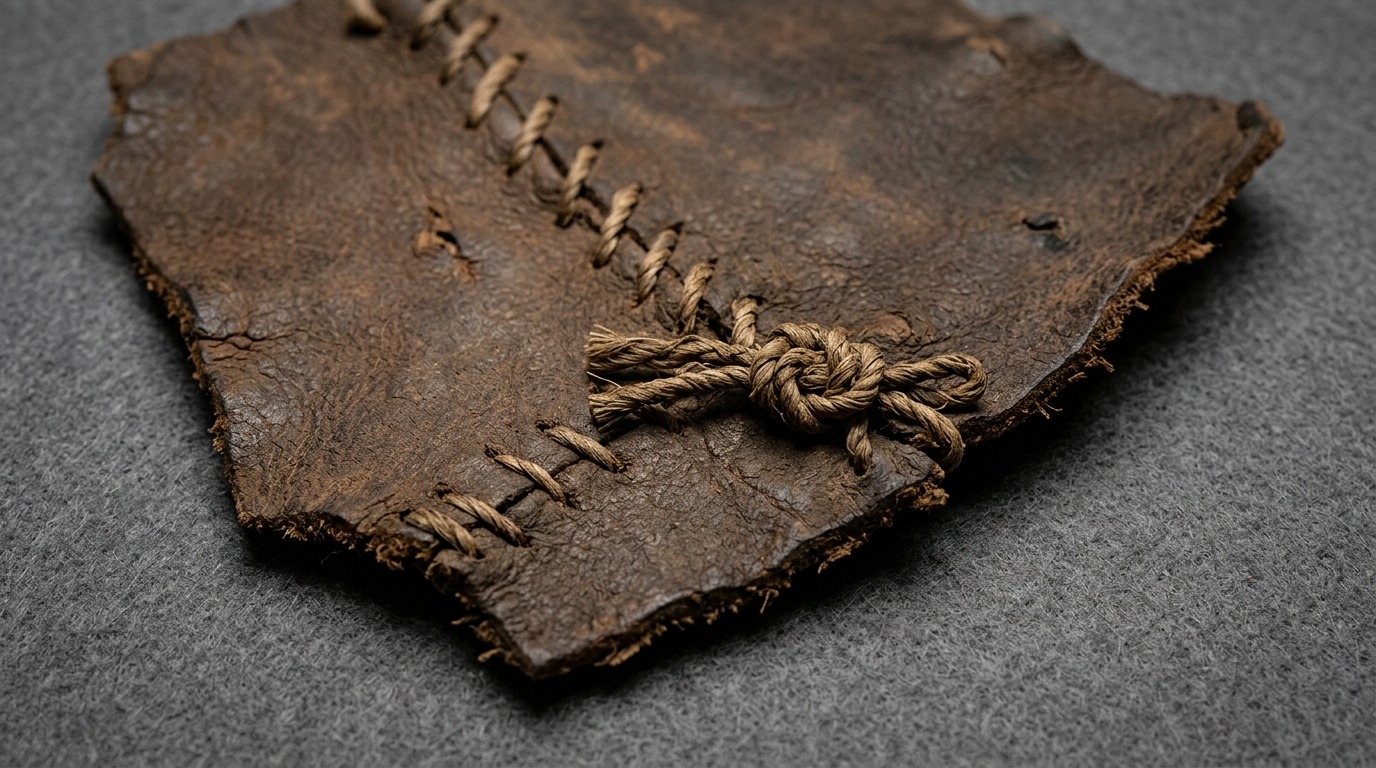
A fragment of sewn hide — traces of cord and the joining of several pieces are visible
What Scientists Think About Ancient People’s Clothing
Until now, scientists had to make assumptions about exactly how people of the Ice Age dressed. There were bone needles — so they probably sewed. There were scrapers — so they processed hides. But between “probably sewed” and “here is an actual fragment of sewn clothing” — there is an enormous difference.
Our research is special precisely because we don’t need to make assumptions — we know, thanks to these exceptionally rare objects that tell us these details, — emphasized Rosencrance.
The finds from Cougar Mountain Cave show exactly which hides were used, from which fibers the cords were made, and how the pieces were joined. This transforms hypotheses into confirmed facts.
Context is also important. The find dates to the very end of the Pleistocene — an era when glaciers covered a significant portion of the Northern Hemisphere. The people who inhabited the territory of present-day Oregon 12,600 years ago lived in harsh conditions, and the ability to make quality warm clothing was for them a matter of literal survival. The diversity of technologies discovered in a single cave suggests that these were not primitive attempts but a mature, developed system of skills passed down from generation to generation.

Reconstruction: Ice Age people in sewn clothing made from hides
What Else the Artifacts Revealed About Ancient People’s Lives
In addition to the sewn hide, dozens of other objects were found in the cave, and their diversity is impressive:
- 24 items made of plant fibers: ropes, woven objects, cords;
- 12 wooden tools;
- 3 fragments of processed animal hides.
All of this is evidence that people of the late Pleistocene possessed a wide range of organic material processing technologies. They knew how to weave, twist fibers, and work wood and leather. Such technological diversity in one location is a rarity for such ancient sites, and it significantly enriches our understanding of our ancestors’ daily life.
How Ancient People Transitioned from Hides to Sewn Clothing
The find from Oregon fits into a broader picture of how humanity gradually improved clothing. Bone needles, considered a key tool for sewing, appear in the archaeological record approximately 40,000–50,000 years ago. But a tool is one thing, and a finished product is quite another. The fragment from Cougar Mountain Cave fills precisely this gap: it shows that by the end of the Ice Age, sewing technique was already developed enough to create composite clothing from multiple pieces.
As for buttons — the earliest objects that may have served as fasteners date to approximately 5,000 years ago, although their exact purpose remains a matter of debate. But the very principle of joining clothing pieces, cutting and sewing, as we now see, goes back at least 12,600 years.
This find is a reminder of how much in the history of clothing remains hidden simply because organic materials don’t survive millennia. Every such artifact is a window into a world that is usually invisible to archaeology. And who knows what other discoveries await in museum storage rooms, where unstudied collections from old excavations have sat for decades.