A girl blowing a bubble with chewing gum
Several habits commonly seen as bad, such as swearing, fidgeting, chewing gum or putting tasks off, may offer small benefits, but only in the right dose and context. This is not about smoking or alcohol: those and many other habits strongly accelerate aging and gradually kill us. It concerns habits that are more likely to annoy other people or look impolite than to cause real harm. Some of them turn out to have an unexpected upside, although much of the evidence is short-term, mixed or observational.
What you need to know
- In one ice-water experiment, swearing raised the pain threshold by about 32% and endurance time by about 33%. Made-up “swear words” had no such effect.
- Russia’s consumer health regulator, Rospotrebnadzor, considers sugar-free gum after meals acceptable and recommends daytime naps of around 20 minutes when needed.
- For most healthy adults, the upper limit for caffeine is about 400 mg a day. Links between coffee and lower disease risk are associations, not proof of cause.
- People who bit their nails or sucked their thumbs as children were less often sensitized to common allergens (about 38% vs 49%). The study was observational and does not justify encouraging the habit.
Swearing can raise pain tolerance
In experiments, participants held a hand in ice-cold water while repeating either a familiar swear word or a neutral word. When they swore, they tolerated the pain longer. In one experiment, the pain threshold rose by about 32% and the time people could keep their hand in the water rose by about 33%. Invented “swear words” did not produce the same effect.
The mechanism is not yet clear. One hypothesis is that an emotionally charged word briefly arouses the nervous system: the heart beats faster, and unpleasant sensations are temporarily felt less strongly. The effect is short-lived, however. Swearing more does not make anyone healthier.
Jiggling a leg keeps blood moving during long sitting
When people sit for hours, their leg muscles barely work and do less to help blood move through the vessels. Jiggling a leg or lifting the heel makes the muscles contract and increases blood flow. In one experiment, such movements during three hours of sitting helped blood vessels function better than staying completely still.
This does not replace a walk or a stretch break. There is also an important exception. If the urge to move the legs is impossible to resist, gets worse in the evening, comes with itching or a “crawling” sensation, or interferes with sleep, it may be restless legs syndrome, which is worth seeing a doctor about.
Sugar-free gum after meals helps protect teeth
Chewing increases saliva production. Saliva washes food and sugar residue off the teeth and helps neutralize acids produced by bacteria. For this reason, Rospotrebnadzor considers it acceptable to chew sugar-free gum after eating. Some studies also suggest that chewing briefly increases alertness, but this evidence is contradictory.
All of this applies only to sugar-free gum. Regular gum does the opposite and feeds bacteria. Chewing for hours is also not advisable: it overloads the jaw muscles, and large amounts of some sweeteners can upset the gut.
Two to three cups of coffee a day: alertness within limits
In moderate doses, caffeine reduces fatigue and speeds up reaction time. In 2026, an expert from Krasnoyarsk State Medical University, in material published by Russia’s Ministry of Health, said that two to three cups of coffee a day may improve attention and some aspects of thinking. Large studies have linked moderate coffee consumption with a lower risk of a number of chronic diseases. But that is an association, not proof that coffee itself is responsible for better health.
For most healthy adults, the upper limit is about 400 mg of caffeine a day, although sensitivity varies from person to person. Different limits apply during pregnancy and for some heart and vascular conditions. Mild dependence is also possible: stopping abruptly can cause headaches and irritability.
A 20-minute nap can restore concentration
Rospotrebnadzor advises napping for about 20 minutes during the day if needed. A nap of this length improves wellbeing and concentration, and a person usually does not have time to fall into deep sleep. A 2023 study even linked a daytime napping habit with larger brain volume, although that work does not prove protection against dementia.
Sleeping two to three hours every day, on the other hand, is harmful because it makes it harder to fall asleep at night. A constant strong urge to sleep during the day may point to sleep deprivation or sleep apnea, meaning pauses in breathing during sleep.
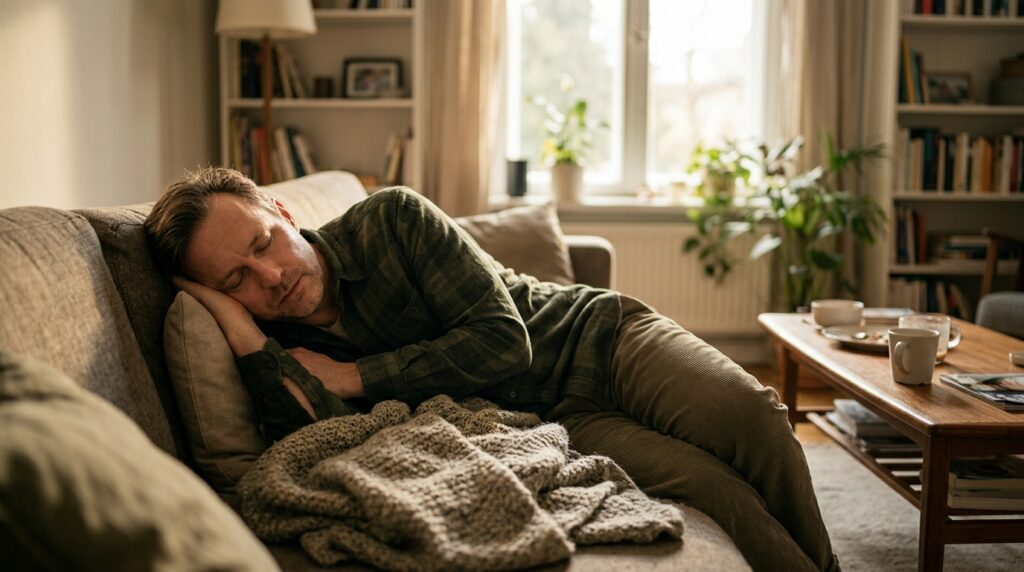
A man sleeping on a sofa in a cozy living room
Video games may train reaction speed and spatial thinking
In 2023, Russian psychologists reviewed a large body of international research and concluded that some games are indeed associated with the development of specific skills. Puzzles and arcade games train spatial thinking, while shooters and action games help players react faster and process visual information more quickly. But there is no general effect along the lines of “games make you smarter”: it depends on the genre.
The results can be contradictory. In a Russian experiment with Fall Guys, people who played regularly scored higher on some measures of thinking, yet a single short gaming session worsened attention. According to the researchers, hours-long gaming marathons that replace sleep, study and physical activity harm mood and everyday life.

A teenager playing a video game with a gamepad in a dark room
Moderate procrastination can help with creative tasks
Constantly putting off important tasks is harmful: stress rises, deadlines are missed and the quality of work suffers. But in creativity research, the best results came neither from people who started a task immediately nor from those who waited until the last minute. They came from people who delayed it moderately. These participants familiarized themselves with the task, switched to something else, and their brains kept working on it in the meantime.
In 2026, Irina Izyumova, a Candidate of Psychological Sciences at Pirogov University, noted that putting things off is sometimes a strategic pause or a form of psychological self-protection rather than laziness. Sketching out ideas in the morning and returning to them in the evening is one thing. Opening a document for the first time ten minutes before the deadline is quite another.
Childhood nail-biting is linked to a lower allergy risk
A long-term study followed people from childhood into adulthood. Among those who bit their nails or sucked their thumbs as children, sensitivity to common allergens was found in about 38%, compared with 49% among the rest. One possible explanation is the hygiene hypothesis: early contact with a variety of microbes “trains” the immune system.
That does not mean children should be encouraged to bite their nails. The study was observational: it shows an association, not a cause. The habit itself damages skin and nails, can affect the bite and can introduce infections.
The common thread: dose and context
Many of these habits earned their bad reputation mainly because they irritate other people or look like laziness, not because they are always harmful to health. Any benefit appears only in a certain amount and in the right situation: 20 minutes of sleep rather than three hours, a couple of cups of coffee rather than liters of energy drinks, and sugar-free gum after a meal rather than all day long. Cross that line, and an advantage quickly turns into a drawback.