
Superstitions comfort us, but we don’t even notice it
You’re probably familiar with this feeling: you spill some salt, and your hand automatically reaches to toss a pinch over your left shoulder. Or, when you go back for something you forgot, you always look in the mirror to “neutralize” the bad luck. Meanwhile, our rational brain knows perfectly well that a black cat crossed your path not because it’s planning to ruin your job interview, and salt is just sodium chloride that has no effect on family arguments. So why do we keep playing by these ancient rules, even when logic tells us they’re absurd?
Superstitions Create an Illusion of Control
The main reason we believe in superstitions is humanity’s total aversion to uncertainty. The brain expends a colossal amount of energy on stress when it doesn’t know what tomorrow will bring. To calm down, the psyche creates a powerful illusion of control. The ritual of wearing a “lucky” shirt before a job interview or the habit of not turning back mid-trip — these are ways to feel like you can influence the chaos.
In psychology, this is called a cognitive bias. It’s easier for us to believe that we “jinxed” ourselves with some strange sign than to admit that the world around us is unpredictable and many events simply happen by chance. We start to feel afraid, and then we knock on wood to calm ourselves down.
Superstitions Reduce Anxiety Levels
Superstitions serve as a defense mechanism. Imagine you’re waiting for important news. Your anxiety level is through the roof. If at that moment you perform a small ritual (for example, not taking out the trash in the evening), your psyche receives a signal:
I’ve done everything to make sure things go well.
In reality, we use superstitions as a fast-acting antidepressant. They reduce the intensity of stress, allowing us to stay sane in conditions of uncertainty.
Superstitions Help Us Let Go of Responsibility
Psychologists note another interesting feature. When failure occurs, it’s painful for a person to admit that they made a mistake, didn’t get enough sleep, or were poorly prepared. The psyche defends itself, and the search for a “culprit” begins. Who’s to blame for the deal falling through? Not my lack of preparation, but that black cat that crossed my path in the morning.
Superstitions become a convenient scapegoat. They allow us to preserve our self-esteem by blaming failure on external mystical circumstances.
We Associate Luck with Objects
Why do we continue to believe in a superstition even when we know it’s nonsense? The culprit is the selectivity of our memory. This phenomenon is called reinforcement through random coincidences.
Let’s say you wore your “lucky” brooch and successfully delivered a project. The brain instantly registers a connection:
Brooch = success.
But if you wear it tomorrow and fail, the brain will prefer to forget this or find another excuse (for example, “it wasn’t the right day”). We don’t notice the thousands of cases when superstitions didn’t work, but we vividly remember those rare instances when they “worked.” This is a systematic error: we see what we want to confirm.
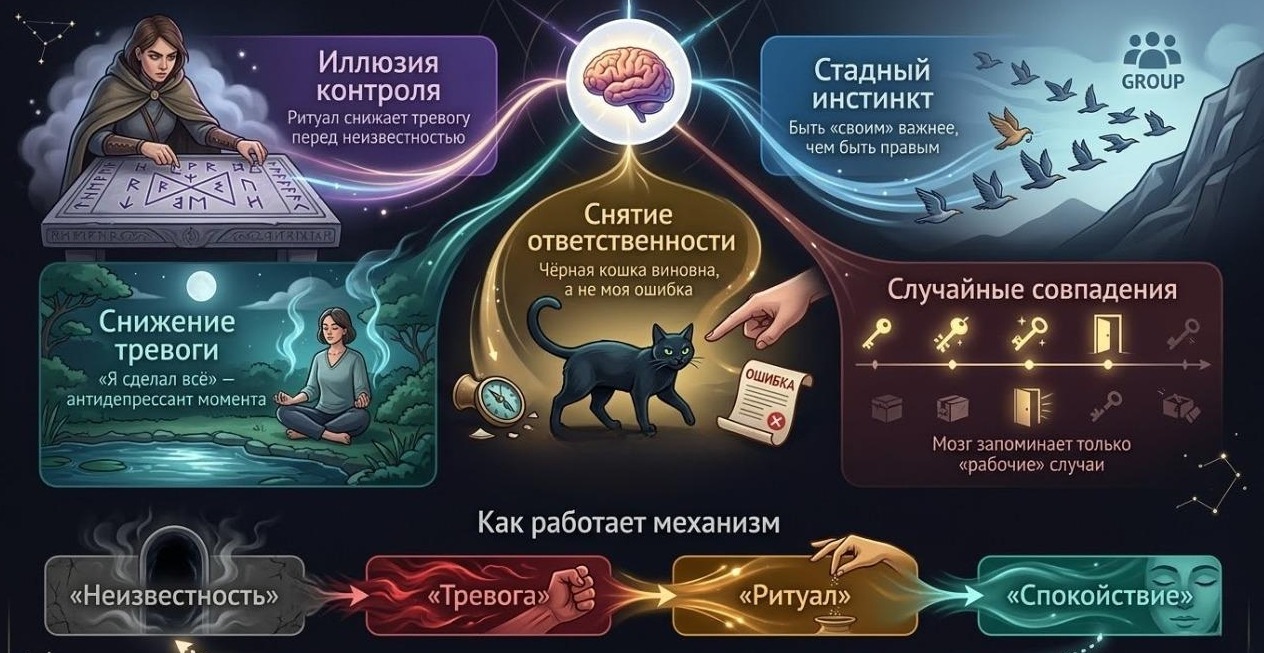
A brief diagram of why we believe in superstitions
Superstitions Are Supported by Herd Instinct
Belief in superstitions is also a powerful social mechanism. If in your family or workplace it’s customary to “knock on wood” or not shake hands across a threshold, breaking this rule means going against the group. We fear judgment. We don’t want to catch sideways glances or hear:
What, are you trying to jinx it?
Following superstitions often becomes a social norm, especially during pivotal life moments: weddings, funerals, exams. We do it not because we believe, but because we want to belong and not provoke anxiety in those around us.
Modern media only adds fuel to the fire. Horror movies about curses, social media posts about “negative energy,” and horoscopes create global trends. What used to be a local village tale now becomes a meme and spreads around the world.
We Learn About Superstitions from Older Generations
According to b17.ru, superstitions have a deep historical foundation. Our ancestors lived in a world without weather forecasts, medicine, or the internet. Diseases, crop failures, and natural disasters were chaos that needed to be explained somehow. Superstitions became an attempt to bring order to this chaos, to create an understandable system of rules:
If you do this, you’ll avoid trouble.
This knowledge was passed down from generation to generation, embedding itself into the cultural code. Even an atheist raised in Slavic culture subconsciously knows that broken dishes mean “good luck” and over-salted food means “someone’s in love.” In Eastern traditions, this manifests through feng shui rules, where the placement of a couch supposedly “affects” financial flows.
The most interesting thing is that belief in superstitions is rarely absolute. A person can perfectly coexist in two realities simultaneously. They might chuckle at a superstitious colleague but still “sit down before a journey” before an important trip. Psychologists call this cognitive dissonance, which we easily overcome with the phrase: “Just in case.”
Essentially, superstitions are not so much a matter of mysticism as they are a tool for psychological hygiene. They don’t control the weather or destiny, but they do manage our anxiety, help us feel connected to our ancestors, and find common ground with those around us. And as long as the world remains unpredictable, knocking on wood will remain the most harmless and effective way to tell ourselves: “I’m in control.”